

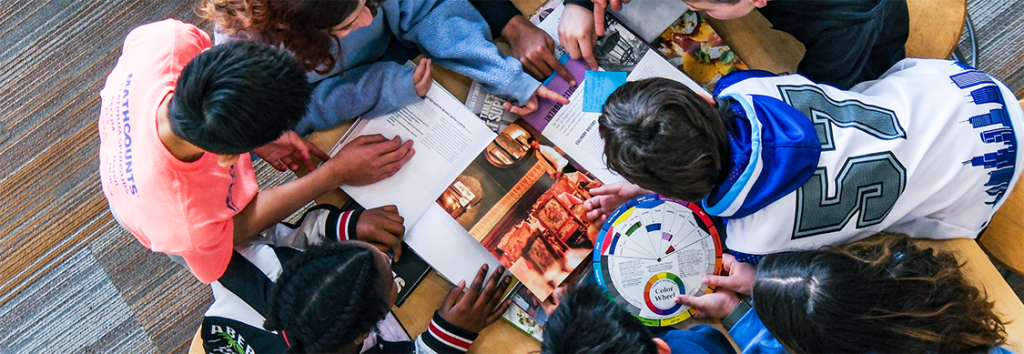
Outside Katie Taylor’s and Marcella Brideson’s sixth-grade language arts and world cultures classrooms, students have spilled into the hallway, clustered around tablets and draft pages, peering over one another’s shoulders.
One group debates color palettes. A warm orange, someone argues, feels more inviting. Another student isn’t convinced; it competes with the photographs. Across the room, classmates compare fonts, weighing artistry against readability. At another table, a student reads a story aloud about her grandmother leaving Italy, pausing over a single sentence while the rest of the group searches for the right word. Nearby, sketches and illustrations are spread across a table as students decide which image best captures someone else’s family recipe.
It feels less like a sixth-grade language arts or world cultures classroom than a design studio. For much of the year, it has been exactly that.
Over the last year, these students stepped into the roles of writers, editors, illustrators, designers, researchers, and publicists to produce Our Table, Our Stories: Made with CARE, the inaugural Charger Community Cookbook. The project emerged from a year-long collaboration among sixth-grade language arts and social studies, advisory, and Cary Academy’s Center for Community Engagement.
The finished book is impressive in its own right. Filled with family recipes, personal narratives, original artwork, and thoughtful design, it is both a family keepsake and a practical cookbook. Written, designed, marketed, and sold by students, it has raised more than $5,000 for organizations advancing food justice across the Triangle. But the project tells another story as well. It reveals how learning happens at Cary Academy.
MORE THAN A MEAL
The cookbook may have taken shape in publishing committees, but the learning that produced it began months earlier.
Throughout the year, students examine how geography shapes civilizations, how cultures evolve, and how traditions change as people migrate and communities interact. In language arts, they explore how language preserves memory, influences identity, and reflects the values of individuals and communities.
For Taylor and Brideson, the challenge was to move those ideas beyond the abstract by giving students a personal point of entry. They found that entry point in a deceptively simple question: How does food shape our culture and identity?
The project began intentionally with students’ own experiences, inviting them to discover culture through the stories, recipes, and people closest to them. “We wanted them to understand, in a very personal way, how food has shaped their family stories, their identities, and the cultures they call their own,” explains Taylor. Starting there, students built a foundation for exploring the larger historical and cultural concepts they encountered throughout the year.
Students kept returning to the same questions across the sixth-grade experience. Discussions that began in social studies continued in language arts, while advisory encouraged students to reflect on identity, belonging, and their responsibilities to one another. Through the Center for Community Engagement, those same questions extended into service learning.
Language arts explored identity, memory, and belonging through food narratives and professional food writing. Social studies examined culture, geography, migration, and food insecurity. Service learning invited students to engage with those ideas in the community.
Those repeated connections were intentional, explains Service Learning Director Maggie Grant. “The more touchpoints we can have tying all these threads together,” she explains, “the more students understand not just the problem, but why it matters—for their learning, their identity development, and their understanding of care and community.”
As students’ understanding deepened, so did the central question: How have history, geography, transportation, economics, and public policy affected what ends up on someone’s dinner table—and, ultimately, the identities and opportunities available to the people gathered around it?
Underlying the work was CARE (Community, Awareness, Respect, and Empathy), a new sixth-grade social-emotional learning (SEL) framework. Developed by Grant in partnership with sixth-grade lead advisors, it offered students a common language for listening with curiosity, giving thoughtful feedback, approaching unfamiliar experiences with empathy, and remaining open to different perspectives.
By naming those habits explicitly, teachers helped students recognize them as transferable skills they could carry from one classroom, project, or experience to the next. “The more specific we are about naming a skill,” Brideson explains, “the more likely students are to recognize it later and use it again.”
For Head of Middle School Josette Huntress, that’s exactly the point.
“Projects like this broaden the way we think about rigor,” Huntress says. “Certainly, students are becoming stronger writers, researchers, designers, and collaborators. But they’re also learning to navigate ambiguity, ask better questions, build empathy, and create something that matters beyond themselves. Those are the habits that prepare them not just for Middle and Upper School, but for life beyond Cary Academy.”
THE STORIES WE CARRY
If food opened the conversation about culture and identity, the interviews brought it much closer to home.
Every sixth grader interviewed someone important in their life—a parent, grandparent, family friend, neighbor, or mentor—about a favorite recipe. The goal wasn’t simply to record a recipe, but to understand the people, memories, and origins that gave it meaning.
For many students, it was their first independent interview. Before they could become writers, editors, or designers, they first had to become curious, prepared listeners.
Those skills had been developing all year. Early in sixth grade, students conducted empathy interviews with members of the Cary Academy community, practicing thoughtful questioning while learning about the people whose work helps the school function every day.
“Communication is a skill, and like any skill, you develop it through practice,” offers Taylor. “They realized in the moment how challenging it can be to actually get at something meaningful. You have to listen to understand rather than simply waiting for the next question. And sometimes you have to go back and try again.”
Evelyn Gorman realized after interviewing her father that she had captured his recipe for Matzo Ball Soup, but not the story behind it or its important connection to her Jewish identity.
“I went back and prepared,” she says. “I got some basic core questions that I wanted to ask.”
She interviewed him again—and then a third time—each conversation bringing her a little closer to the story she was trying to tell.
Skye Slone’s interview stretched across three generations as her mother translated between Vietnamese and English while she and her grandmother talked through the recipe for “Grandma’s Pho,” bridging three generations in a single conversation.
Lilliana Boles expected to learn about her family’s Macaroni Aglio and Olio recipe. Instead, she found herself hearing about her grandmother’s childhood in Italy before immigrating to the United States—a chapter of family history that, she says, “isn’t really talked about much.”
What began as family storytelling gradually became cultural inquiry. Across dozens of interviews, students found that recipes aren’t static. As families migrate, adapt to new communities, or substitute ingredients they can no longer find, recipes change too. They began asking not only how food reflects culture, but how culture itself changes when familiar ingredients, traditions, and communities change. What endured wasn’t always the exact recipe, but the history, identity, and sense of belonging it carried from one generation to the next.
For many students, those conversations were unlike any they had shared with their families before. “They’d never intentionally made space to listen to their parents, to really learn from them in that way,” Brideson says.
She believes those conversations gave students something increasingly rare: an authentic reason to write. At a time when many wonder why they should write when technology can generate it, this project offered an answer. They weren’t responding to a prompt or completing just another assignment. They were preserving stories that belonged to their own families. “And no one can tell your family story better than you,” says Brideson.
Students returned to school with tablets full of recipes, memories, and family histories. As they read one another’s work, they began to discover their classmates much as they had discovered their own families.
“I never really see most of my classmates outside of class,” Penelope DiFrancesco reflects. “It was cool to hear about their families, their backgrounds, and the things that are important to them. I feel like that helped me not just learn about them but also connect more with new people.”
Those connections mattered. Each fall, Cary Academy’s sixth grade brings together students from schools across the Triangle and beyond. Helping those students become a community is one of the sixth grade’s central goals, Taylor explains. With the cookbook, students began learning about one another before they were asked to learn alongside one another.
For Brideson, that sense of community isn’t separate from rigorous learning—it’s what makes it possible. “Students can’t truly discover, innovate, collaborate, or pursue excellence until they feel safe,” she says. “If they don’t feel respected, how are they supposed to share their family stories, their family memories, and those vulnerable parts of themselves?”
As students read one another’s work, the project expanded beyond individual family stories. They encountered unfamiliar traditions, recognized unexpected similarities, and developed a richer understanding of the remarkable diversity within their sixth-grade class.
By the time the first drafts were complete, students had collected far more than recipes. They had gathered dozens of family histories—and begun to understand what food revealed about themselves, one another, and the community they were building.
The next question asked them to look beyond their own tables.
BEYOND OUR OWN TABLES
Through the Center for Community Engagement, students expanded their understanding of food beyond culture and identity, examining questions of access, equity, and community.
They packed weekend meal bags for local elementary students through Backpack Buddies while researching other organizations working across the food system, from school meal programs and emergency food assistance to community farms and food cooperatives. Along the way, they came to see food insecurity not only as a lack of food but as a complex issue informed by access, transportation, affordability, and the ability to obtain culturally meaningful food.
One advisory experience brought those ideas into especially sharp focus. Working in groups, students were assigned different grocery stores—from Whole Foods and Harris Teeter to Food Lion, Dollar General, and Walgreens. Each group received the same budget and was asked to evaluate its store based on affordability, nutrition, quality, and accessibility.
The exercise quickly stopped being about groceries. Instead of debating what people should eat, students found themselves asking what families could realistically afford, what foods were available in different neighborhoods, and how transportation—or the lack of it—influenced those choices. The focus had shifted from individual decisions to the systems that shape them.
Grant hopes experiences like these lead students to something deeper. “It’s easy, especially in a community of privilege, to give money,” she says. “And that matters. But it doesn’t necessarily help you understand the problem or build the kind of empathy that leads to more thoughtful action.”
For Grant, the goal isn’t simply for students to care about food insecurity. It’s for them to begin asking better questions about it. Not simply “Who needs help?” but “Why?” Not simply “What can we do today?” but “What circumstances and systems created this need in the first place?”
When it came time to decide where the cookbook’s proceeds would go, students approached the decision differently because they had already examined the issue from multiple perspectives. Rather than simply choosing charities, they evaluated different approaches to food justice, presented their findings to classmates, and ultimately voted on the organizations that would benefit from the cookbook’s proceeds.
For Madison Clarke, the connection was clear. “I never really thought about the grade,” she reflects. “I thought, ‘How can I help the community?'”
MAKING A BOOK
Writing the stories was only the beginning. Producing Our Table, Our Stories required students to organize themselves into a publishing team, with committees responsible for editing, illustration, layout, photography, marketing, fundraising, proofreading, and logistics.
“Working together to publish a real book isn’t something a lot of sixth graders get to do,” Madison reflects.
In the layout committee, students received a crash course in graphic design from Cary Academy Brand Designer Joe Lavender, learning that typography, color, white space, and imagery all shape a reader’s experience. What looked effortless in the finished cookbook was the product of countless intentional decisions.
“It was really hard getting the right colors to match,” Vigyann Singan recalls. “You had to be really precise.”
That attention to detail was just one part of a much larger effort. No committee could complete the book alone, and students learned that success depended less on individual achievement than on what they could accomplish collectively.
“I liked that it was the whole grade working together, not who could make the best this or the best that. It was collaborative, not competitive,” shares Madison.Collaboration proved to be one of the project’s greatest challenges and most enduring lessons. Every committee required students to navigate disagreement, offer constructive criticism, receive feedback graciously, and work toward consensus.
For Penelope, learning to collaborate became one of the project’s most lasting lessons. “Collaborating with your group is really important,” she offers. “It can sometimes be hard to find the balance between putting in your ideas and listening to other people’s.”
For Brideson, those moments reinforced the CARE habits students had been practicing throughout the year. “Learning to actively listen, giving constructive feedback with kindness, approaching a new experience with curiosity—those are skills that we intentionally named throughout this project,” Brideson explains.
Editors came to understand that good editing isn’t about making someone else’s writing sound smarter but about preserving voice and perspective.
“If you just do autocorrect,” explains Caleb Monds, “it makes it sound more like a robot than an actual kid writing something. You have to keep it simple.”
Illustrators learned that creating artwork for someone else’s story required as much conversation as drawing. Designers defended ideas while remaining open to better ones. Student marketers partnered with Cary Academy’s Communications team to learn how to craft compelling publicity, while the logistics committee worked with the Development Office on distribution and fundraising. Students quickly discovered that publishing a book involves much more than writing it.
Knowing the cookbook would be shared beyond the classroom gave the work a different kind of responsibility.
“We wanted to do our best,” Evelyn says. “Other people who aren’t at Cary Academy are going to see this. We’re basically representing our school.”
For Vigyaan, the finished cookbook represented something larger than any individual contribution. “I’m most proud of the final product because we all put in the effort,” he says. “We all contributed to it.”
By the end of the project, ownership had shifted. Students no longer talked about their page. They talked about our book.
MORE THAN A COOKBOOK
When Our Table, Our Stories arrived from the printer, the project quietly began leaving the classroom.
At a culminating potluck, students finally experienced the finished cookbook as a class. Families had entrusted them with recipes and stories for months. Now those stories returned to the table, not as interviews or drafts, but as dishes shared among classmates. Students sampled one another’s family traditions and celebrated the book they had created.
Read cover to cover, Our Table, Our Stories reveals an extraordinary range of experiences within a single sixth-grade class. Some recipes trace journeys across continents. Others have been passed from one generation to the next within the same family. Holiday traditions sit beside weeknight comfort food. Some stories begin thousands of miles from campus. Others begin just a few miles away.
No two are alike. Collectively, they tell the story of a community.
The finished cookbook is the tangible result of a year’s worth of inquiry, collaboration, and creation. Its real legacy lives in sixth graders signing a published story for a grandparent, classmates gathering around a table to celebrate one another’s cultural heritage, and a learning community where students make connections between ideas, disciplines, people, and communities in ways that extend beyond the classroom.