

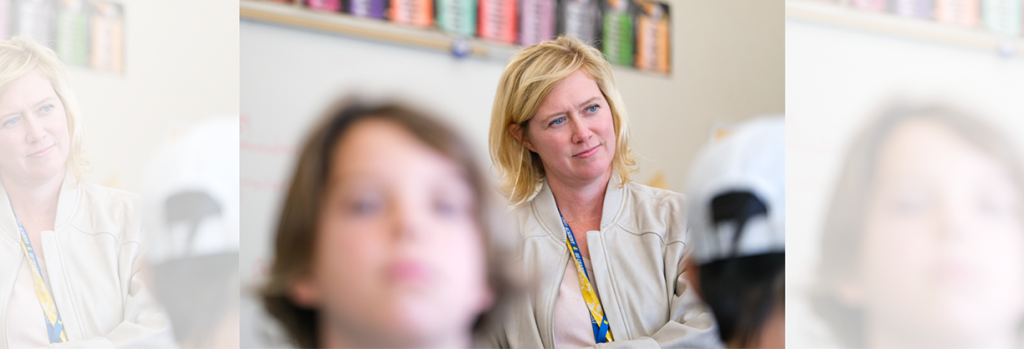
Long before Lucy Dawson became Cary Academy’s Middle School Dean of Students—and long before she helped shape a seventh-grade humanities experience known for its intellectual depth, interdisciplinary connections, and student-centered care—she was a seventh grader in Charlotte, North Carolina, falling in love with learning for the first time.
“I had this amazing teacher, Ms. Marshall,” she recalls. “Seventh grade is when I really fell in love with school—reading, poetry, stories, literature. It all just opened up for me.”
The moment was formative. Not because everything suddenly became easy, but because it felt meaningful, human, connected, alive. That feeling would become the compass for Lucy’s life and work.
“I’ve always known I love people and I love ideas,” she says. “Teaching was where those two things came together for me.”
A Natural Fit
Lucy’s path into education took a few scenic detours: a year studying philosophy, theology, and biblical languages at Princeton Seminary; nonprofit work in Washington, D.C. and then a return to academics that reaffirmed what she already sensed as an English major at Duke University: she loved literature, ideas, and the complexity of human stories and connection.
After several years of teaching high school English in Alexandria and Baltimore, the pull to return home to North Carolina led her to Cary Academy.
“When I began exploring schools in North Carolina, equity needed to be front and center,” she says. “That was my first question in the interview, and I could tell immediately that it really mattered here.”
Just as striking was the collaborative spirit. “The collaboration piece was huge for me,” she says. “I saw right away that CA teachers didn’t work in isolation; people were constantly sharing ideas, building things together, thinking creatively. It was unlike anything I’d seen before.”
She was energized by CA’s forward-looking approach to pedagogy and professional growth. “The innovation, the PD opportunities, the freedom to try new things. It felt like everyone had their finger on the pulse of what was happening in education.”
Though her earlier experience was largely in high schools, she felt immediately at home in Middle School. “I really love this age group,” she says. “Seventh grade was my big intellectual awakening. Now, getting to experience that alongside my students—those moments when a kid gets excited about a book or a poem or a historical idea for the first time—that feels so special to be part of.”
The Art of Knowing
Last year, Lucy stepped into the Middle School Dean of Students role—a natural extension of how she’s always taught.
“To me, the dean’s job is to know every kid in the Middle School,” she says. “To have a relationship where you can have hard conversations, where you can hold them accountable, where you can say, ‘Hey, that wasn’t your best choice,’ but they still know you care about them. Kids are supposed to mess up; that’s how they learn. But they have to know you’re on their side.”
These carefully tended relationships aren’t an add-on; they’re the backbone that enables academic excellence.
“If kids know you care about them, that you really know them,” she says, “they’ll take risks, think deeply, and experience that real intellectual thrill. It’s when learning really takes hold.”
Her care and the vulnerability it engenders in her students is evident in small moments—greeting students at break, checking in after a tough interaction, and noticing when someone seems off—and in bigger ones, like when a student courageously performs an original poem or shares personal writing.
It also shapes her work building a cohesive sixth-through-eighth advisory and SEL program that is developmentally aligned and skills-based in close collaboration with Student Support Services and lead advisors.
“Those skills aren’t extra; they make deep learning possible,” Lucy explains. “They allow students to handle challenges, collaborate effectively, and push their thinking further.”
Threads that Connect
As seventh-grade team lead, Lucy has helped shape CA’s integrated humanities curriculum—uniting Language Arts and World History to cultivate analytical reading, writing, and reasoning through inquiry-driven learning.
“I want to be clear—it’s not just me,” she emphasizes. “It’s the whole seventh-grade team. We’ve spent years asking: What really matters? What will engage our students right now? We’ve tried new things, reflected, and built on what works. Over time, it’s deepened and strengthened.”
Seventh-grade history sits at the hinge of a three-year sequence—World Cultures (sixth), World History (seventh), U.S. History (eighth)—where students wrestle with identity, power, and place.
“Unlike more traditional sequences, our curriculum brings Africa, the Americas, and Europe into conversation,” Lucy explains. “Students study how land, culture, and identity shape one another—and how communities have responded to colonization, migration, and change.”
Language Arts carries those ideas into creative practice. Students read widely, compare texts across media, and examine how language shapes voice and power—particularly their own. They draft, revise, and workshop their writing with evidence-based feedback.
“Especially in middle school, when you’re so self-conscious, you have to build trust so students can be honest and brave,” Lucy says. “When students trust the space, they’re willing to go deeper. That’s when the real thinking happens.”
The result isn’t just preparation for upper-level work; it’s an invitation to see themselves as thinkers and changemakers now.
Becoming Thinkers
Ask Lucy what seventh graders gain from the humanities, and she won’t start with outputs; she’ll start with experiences.
“They learn the danger of a single story,” she says. “They learn to embrace multiple perspectives, to step outside their own experience, to understand their own positionality.”
Those ideas appear everywhere: in close reading and argument, in primary-source analysis, in conversations about identity and belonging. Students evaluate sources, analyze author craft, and connect learning across subjects.
It all adds up to students who not only think critically but feel confident doing so. “Our kids can do a lot,” Lucy says. “They want to be challenged. They want to take on big ideas. And when the community holds them with care and high expectations, they rise to that.”
Joy in the Middle
Some of Lucy’s favorite CA moments happen in the everyday rhythms of Middle School life: a student lingering after class to share something important, a quick hallway exchange that becomes a breakthrough, a kid’s unexpected insight that reframes an entire conversation.
“The special mix of explosive intellectual growth and ‘I’m still just a kid’—that’s what I love,” she says. “Middle schoolers can ask a brilliant, complex question one minute and then do something hilarious or completely unexpected the next. It keeps you grounded.”
Two community traditions also capture that spirit: the annual Poetry & Hip-Hop Showcase and African Voices Day, created with Durham’s Magic of African Rhythm and CA families.
“It’s kids being their full selves—sharing their identities, their cultures, their language,” Lucy says of the showcase. “It’s joyful, powerful, and deeply affirming.”
Of African Voices: “That day captures the essence of community—parents sharing culture, students learning through music and history, everyone connected.”
These experiences deepen cultural literacy and empathy while strengthening the relationships that make rigorous learning possible.
Doing the Hard Work
Lucy’s commitment to community includes longstanding involvement in WERJ (White Employees for Racial Justice), a faculty affinity group centered on reflection, accountability, and allyship.
“WERJ is some of the hardest work I do,” she says. “It’s complex. It’s slow. It requires courage and patience. But it matters. We’re trying to be thoughtful about how we push ourselves, how we can be an anti-racist resource for the community, and how we can foster a culture of accountability.”
It is work aligned with CA’s mission and strategic goals, ensuring that every student is both known and challenged and that equity is foundational to the CA experience.
Being Human
Asked what she hopes students learn from her beyond academics, Lucy smiles. “I think students see me laugh a lot,” she says. “They see joy. They see that I don’t take myself too seriously, that I make mistakes, that I can be silly. And I think that gives them permission to do the same, to be human.”
She recalls a morning when a former advisee arrived not in her usual bright mood. “I said, ‘I’m so glad you’re in a bad mood today. That is just fine.’ I think especially for girls, it’s powerful to hear that they don’t always have to be positive. They can be a little salty,” she laughs. “They can need space. That’s okay.”
It’s a small moment, but it captures Lucy’s philosophy: belonging isn’t about perfection; it’s about being real.
Full Circle
From the seventh grader who once fell in love with stories to the educator who now helps others do the same, Lucy Dawson’s work is, and always has been, about connection: between people, ideas, histories, and purpose.
And when that connection clicks, you can feel it.
“There’s a buzz,” she says. “Even when it’s quiet, deep, thoughtful work—you can feel that they’re in it.”
That’s when seventh graders fall in love with learning. Just like Lucy did.