

The best stories do more than show us another life; they reveal something of our shared humanity. At just 23, award-winning multimedia journalist Max Feliu, ‘21, is already building a career around that belief, reporting across borders, cultures, and media in pursuit of the deeper stories that connect us.
Born in Barcelona and shaped by experiences living across cultures, Max Feliu understands that the world can look very different depending on where one stands. That perspective shapes how he works as an associate producer on CNN’s international desk, where he helps guide stories from their earliest conception through digital publication.
Just one year out of the University of North Carolina at Chapel Hill, he has already worked with CNN, the Associated Press, and PBS; contributed to Emmy Award-winning work; and earned national recognition for his documentary storytelling. A Fulbright award will soon take him to Chile’s Atacama Desert for his next project.
When Feliu talks about what drives him, however, he focuses less on accolades and destinations than on the people whose lives form the heart of his work.
Whether reporting on a family living beside an Argentine landfill or farmers sustaining themselves in a place that appears incapable of supporting life, he looks for what remains recognizable beneath the unfamiliar—a parent’s hope for a child, the struggle to build a safer future, the ingenuity required to endure in a difficult place.
In a world divided by geography, politics, culture, and competing narratives, Feliu believes that a storycan create moments of recognition across such distances. It may not resolve a conflict or inspire immediate action, but it can make another person’s life harder to reduce to a category, headline, or side.
“I think my biggest motivator,” he says, “is just having people in the world understand that we really aren’t that different.”
FINDING DIRECTION
As a ninth grader, Feliu did not arrive at Cary Academy hoping to become a journalist. An avid tennis player and member of the varsity team, he dreamed more of winning the US Open than of working in a newsroom.
Still, the early outlines of his future were taking shape, not in a single defining moment, but through experiences that showed him how much could be discovered by asking questions, listening closely, and stepping into stories larger than his own.
“There were some early signs of me wanting to be a globally aware person, of being very interested in other cultures, in different voices,” he says.
Those interests found room to grow at CA. Having immigrated from Spain, Feliu understood migration as part of his own identity. Alongside his brother, he established CA’s first immigrant affinity group, creating opportunities to explore that identity and learn from the experiences of others.
During one particularly formative meeting, the group hosted a local Honduran family who shared their journey to the United States, giving Feliu his first real sense of what it meant to listen across difference. The conversation unfolded in Spanish, with Feliu serving as translator for the wider group.
As the family described crossing Mexico as part of a migrant caravan, Feliu felt the gravity of translating an experience far beyond his own. Years later, Feliu can recognize in that exchange an early version of his work today, listening with humility and helping others understand an experience they might not otherwise encounter. Former faculty member Dr. Robert Coven’s Modes of Inquiry course gave Feliu another avenue to pursue those same questions. With the Catalan independence movement shaping his own sense of identity, he used the course to examine the issue more deeply. During a trip home to Spain, he interviewed a pro-separatist politician and incorporated the conversation into his final thesis.
The assignment was academic, but the process was personal. Through interviews, he discovered a way to investigate complexity while also making sense of his own place within it. “By doing those interviews, I gained a direction,” he says. “Those opportunities definitely allowed me to find myself.”
JOURNALIST FIRST
That direction came into further focus at the University of North Carolina at Chapel Hill, as Feliu developed the range to write, shoot, edit, and produce across print, digital, and broadcast platforms. After making his first documentary film as a sophomore, he began to see storytelling as more than an interest. Video quickly became Feliu’s preferred format, letting him follow people closely and bring viewers into the places, relationships, and fallout surrounding a story. Still, he considers himself a journalist first—the medium matters less than the reporting behind it.
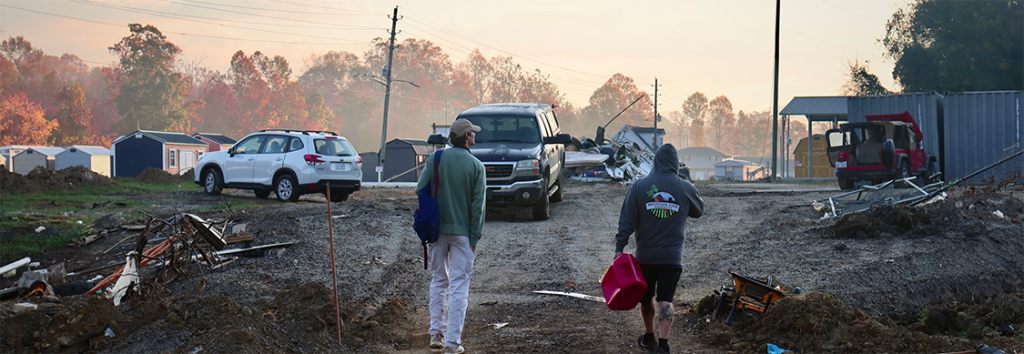
Before graduating, Feliu had already worked with the Associated Press and PBS North Carolina and earned recognition for his documentary work. For PBS’s My Home, NC series, he directed and produced “What the Mud Took,” a documentary about the aftermath of Hurricane Helene in western North Carolina. His work as a producer on the series would go on to earn him an Emmy in the Magazine Program category.
He is quick to move the conversation away from the accolade. “No one becomes a journalist to win an Emmy,” he says. For Feliu, recognition may offer affirmation, but it is not what gives the work meaning.
“My true passion is in uncovering something and bringing it forth to people,” he says.
That impulse now guides his work at CNN, where his Spanish fluency, cultural background, and interest in international reporting often come together in stories focused on Latin America and the Americas.
Much of the job begins before an assignment exists. Feliu follows developments, cultivates sources, develops ideas, and makes the case for stories he believes deserve attention.
One such idea became “Colombia at a Crossroads,” a multimedia project examining renewed conflict and the threat of landmines through the rural communities living with their consequences. Feliu helped develop the story from its earliest stages, locating sources, shaping the editorial approach, and coordinating the logistics required to report from remote areas.
When an idea moves forward, he prefers to remain involved as it moves from pitch to finished piece. Depending on the project, that may mean arranging interviews, working with correspondents, writing, producing, shooting, or editing.
A WIDER VIEW
Feliu’s favorite stories tend to move on two levels at once. They are grounded in the experience of a particular person or family while also revealing something larger about the social, environmental, or political forces surrounding them.
“Having that parallel narrative is very important,” he says, “in having something bigger that isn’t just localized into one person but really connects to a more global audience.”
“What the Mud Took” approaches Hurricane Helene through one family’s loss, widening to the long uncertainty of recovery after public attention begins to move elsewhere. “Colombia at a Crossroads” brings the threat of landmines and renewed guerrilla violence into the daily lives of rural communities deciding where they can safely live, work, and build a future.
Feliu found the same interplay between the personal and the systemic while shooting “Tierra Quemada” in Argentina, where he followed a family living beside La Quema, the largest open-air landfill in South America. The piece explores a community shaped by toxic smoke, economic hardship, and the difficult reality that the landfill threatens residents’ health while also providing work for families with few alternatives.
At the center of the story is a family whose young children were already experiencing problems with their lungs. “It is about this landfill and something very specific to a community,” Feliu says, “but the more universal undertone is that everyone wants a better life for their kids.”
Through one family, a distant environmental crisis becomes immediate and human—poverty, labor, public health, and policy are no longer abstract forces. For most, the circumstances may be unfamiliar, but the hopes beneath them are not. In a parent’s desire to protect a child and build a better future, viewers find a point of connection to lives that might otherwise seem far removed from their own.
For Feliu, video makes that connection especially immediate in a way that written facts and data cannot. “There’s a very personal component of video that you can’t necessarily get in writing,” he says. “That parallel narrative really comes to life when it’s on a video screen.”
CARRYING OTHERS’ STORIES
Journalists often enter a person’s life briefly, ask them to share something consequential, gather what the story requires, and leave. Feliu wants to ensure that the person in front of the camera remains more than a source.
“It’s a big weight to carry someone else’s stories,” he says. “Oftentimes, people don’t have true listeners that actually care about what they have to say.”
Taking that responsibility seriously means approaching a story with humility and resisting the urge to decide too quickly what it will become. Feliu tries to “leave all that you thought you knew about the story aside.” Even under the pressure of a newsroom deadline, he slows down enough to listen without forcing a person’s experience into the premise he arrived with. Often, he explains, the deeper story emerges only after that premise has been set aside.
That humility also shapes how Feliu understands his role. He rejects, he says, the idea that a journalist arrives as “this savior who’s suddenly giving [his subjects] a platform.” The people he interviews do not need him to give them a voice. His responsibility is “to illustrate something in their lives that is worth sharing and that people would benefit from learning.”
The person watching Feliu’s stories may never travel to rural Colombia, rebuild a home in Swannanoa, or live beside a burning landfill in Argentina. His stories may not change policy or produce a visible response the next day. He hopes, however, that they make distant life harder to dismiss, unsettle an easy conclusion, and reveal universal hopes, fears, and desires that connect humankind across very different circumstances.
For him, that understanding matters beyond the story itself. It can shape how people regard those whose lives, backgrounds, or perspectives seem far removed from their own.
“If you care about what other people do across the world, even if you will never interact with them or have anything to do with them, you will be a better citizen in your own community. You will have more empathy towards other people,” shares Feliu.
“I think we’re not seeing enough of that in the world. That is my purpose in doing this work.”
INTO THE DESERT
For him, that purpose will take Feliu to northern Chile. Through a Fulbright Open Study/Research Award, he will spend the coming year producing a documentary in the Atacama Desert, where agricultural communities have sustained themselves for generations in one of the driest places on Earth.
The film will examine how people adapt to environmental extremes and what their experience reveals for communities elsewhere confronting a changing climate. As with his earlier work, the larger questions will be grounded in the lives of the people who know the landscape most intimately.
Feliu will arrive with research, a proposal, and an idea of what the documentary might become. The reporting will determine the rest.
The project carries him into the next stage of a career still taking shape while returning him to the practice that first gave him direction at CA. He will follow the questions, listen closely, and search for the human story within a landscape that may seem impossibly remote. In doing so, he hopes to make the distance between that life and our own feel a little smaller.