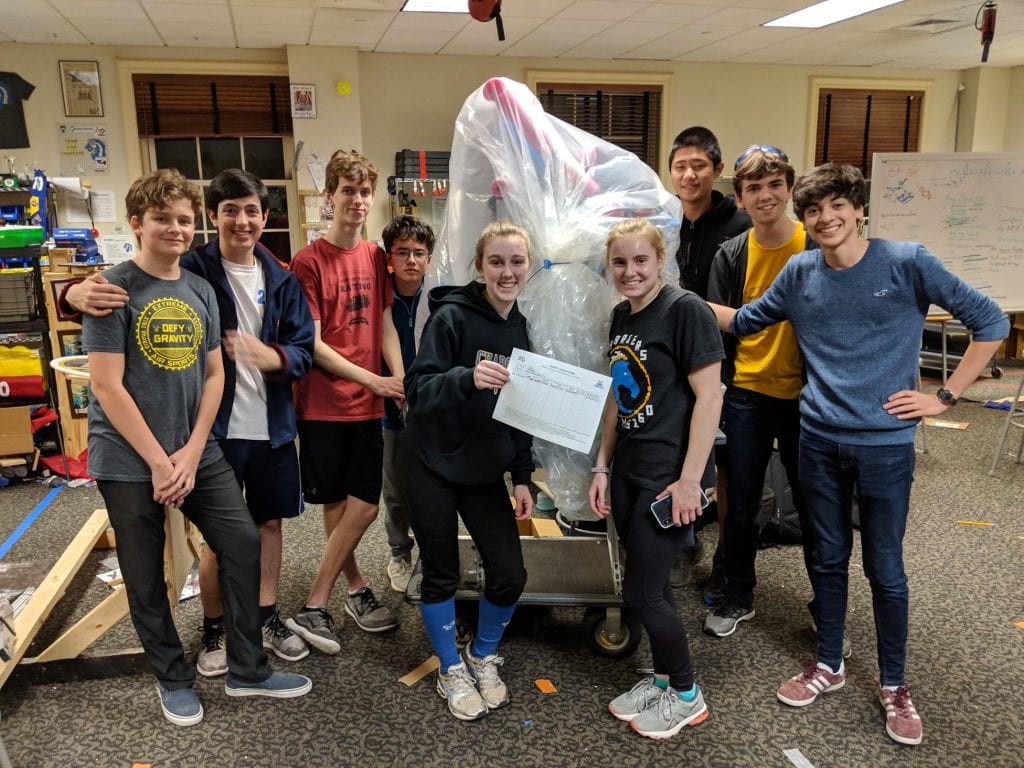
Varsity Robotic Team bagged and tagged

Upper School

Varsity Robotics’ last-ever ‘Bag Day’

February 20, 2019

There’s a little-known CA event that has occurred around the third Tuesday of every February since 2014. For Varsity Robotics it’s officially called ‘Stop Build Day,’ but more commonly known as ‘Bag and Tag Day,’ or simply ‘Bag Day’.

Varsity Robotics competes in the FIRST Robotics Competition (FRC), where students build 120 pound robots designed to conquer the challenges set forth in that particular year’s game. The game is announced on the first Saturday of January, giving teams just six weeks to design, build and test their robot. This six week build time was designed to ensure parity so that all teams had the same amount of time to build, regardless of whether they compete at events in week one or week five of the tournament season.
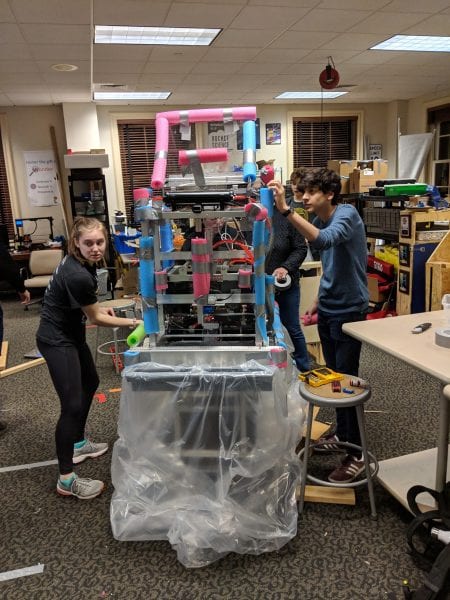
So, every year since the inaugural FRC season at CA, the varsity team has worked in the CA Makerspace after hours, frantically trying to complete their build. While FIRST rules state that teams have until midnight, CA coaches set an internal deadline of 10pm, for the sake and sanity of all involved. Some years we fell short, being snowed out more than once, other years we didn’t make the deadline, only to have to lights go out, resulting in a slow scrambling around the Makerspace guided by our cell phone lights.

Consistent every year, however, was camaraderie, excitement, stress, pizza, good decisions, not-so-good decisions, the thrilling feeling of ‘breaking rules’ by being in the building so late (on a school night, no less) and the ceremony of bagging and tagging the robot.

To an outsider, Bag Day might seem like a mundane task of finishing up and putting a robot in a big bag, but to those of us involved it is ceremonial. It marks the end of build season and the beginning of competition season. It’s a chance to take a breath, step back and look at the machine that was born from collective efforts in design, engineering, creativity, sweat, compromises, hard decisions, duct tape, zip ties and lots of snacks.

Sadly, this was our last bag day. Cary Academy will still compete in FRC, but FIRST has decided to eliminate Bag Day, as it no longer meets its purpose of parity. Removing this restriction will give smaller, less established teams more time for proper drive practice, and the opportunity to perfect their programming and designs; something that larger, more established teams were managing because they had the means and resources to build two robots, bagging one and practicing with the other.

It is a good rule change and one that makes sense, however, I’m sure I’m not the only one who will miss the ceremony of Bag Day. We’ll still have plenty to celebrate and we’ll still have the magic of being an FRC team, because robots rock our world.

Want to experience the delight of robots?

  • Catch our JV (FIRST Tech Challenge) teams in action on February 23rd at the Trinity School of Durham and Chapel Hill. Matches run from 10am – 5pm.
  • See the Varsity (FRC) team compete on March 9 & 10 at Holly Springs High School Matches run from 10:30 am – 6 pm.

– Guest Post by Besty MacDonald, Upper School Design, Programming and Robotics Teacher
Written by

Faculty Reflections

Death rays & grains of sand: The sweet science of a physics fight

Middle School

CA welcomes new Director of Facilities

German Day Results

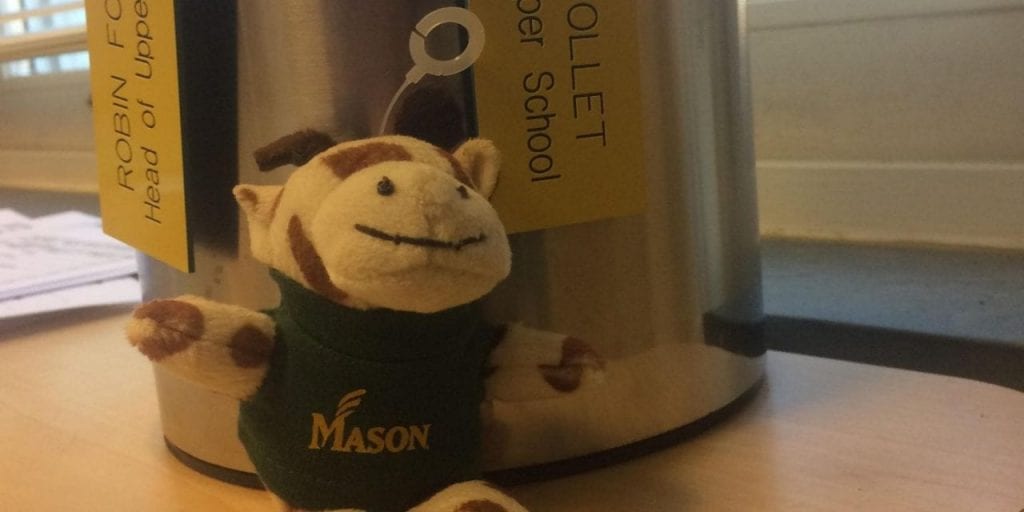
Stuffed animal plush toy

CA Curious

Mason the Giraffe

January 10, 2019

The giraffe, perched on my desk since the beginning of December, smells a bit of maple syrup and IHOP pancakes.

He came to my office, courtesy of a brief conversation I had with the directors of Cary Academy’s Speech and Debate team.  At the start of the school year, I had mentioned to Mr. Pellicciotta and Mrs. Nix that I was curious about the team.  “Even though I’ve been at CA for some time,” I said, “I’ve never actually seen a debate tournament.  I would love to experience one.”

The glint in their eyes should have made me nervous, especially when they both answered, even before I had finished my sentence: “we would love for you to come.  Maybe George Mason?  You could judge.  Since you’re an English teacher, the training wouldn’t take that long.  We promise.”

“Sure,” I said.

“Done,” they said.  The glint sparkled.  Their smiles widened.

So that’s how I found myself, one Friday night in early December, listening to several members of the Speech and Debate team practice their pieces in a hotel on the outskirts of Washington, D.C.  Mrs. Nix was holding court, simultaneously listening to a presenter, offering her suggestions, giving me pointers as a judge, and keeping time.

“Listen to this,” she said.  The student stepped forward, her frame still, a slim folder of prose and poetry in her hands.  Between two breaths, she transformed from a soft-spoken teenager to a dynamo driven by language.  She launched into an impassioned, creative presentation built from the published works of poets and authors.

“Isn’t that fantastic?” Mrs. Nix said to me, before turning to the presenter.  “But let’s talk about what you do with your hands at that one point…”

Other sessions followed that evening—practice for the speakers, and training for me.

The next day, we pulled up to George Mason University, and we all trooped into the student union.  Our kids were buzzing with energy, the adults were chatting, we found our spots in a collection of lunch tables.  Ties were straightened.  Bagels were gobbled.  Coffee was quaffed. And then the day truly began.

That day was a curious mix of energy.  Students scattered to the classrooms around campus, debating, or presenting information, or offering humorous interpretations of stories, or developing impromptu speeches on current events.  After their rounds, they wandered through our dining hall encampment, informing about their perceived successes or mistakes before rushing off to their next presentations.  The adults followed similar patterns: we judged students from other schools, brought the results back from the rounds, and meandered to our Cary Academy claim beside the central stairway and the coffee and sandwich shop.

In those pauses between the official tournament, I watched our students practice their curiosity.  They all generally asked each other that basic question between rounds: “how did you do?” But they quickly moved beyond the simple query.  “Did you hear about that argument the other team made?” “Did that info speaker really reference quantum physics and a North Korean dictator and the Fountain of Youth?*” “Have you thought about trying Humorous Interpretation?  You would be SO good at it!” In short, our students’ excitement and curiosity spilled outward, courtesy of their joy in the activity, the training they had received, and the expectations instilled.

And that curiosity welled up in quieter ways as well.  Students would see me returning from a round and ask, “wait—Mr. Follet, did you just judge Extemp?”  I would reply in the affirmative, and they would ask, “how was it?”  Or we would all be sitting at the tables, and a student would find himself or herself holding forth, and for a few moments, they forgot that I was the Head of Upper School as they expounded on the joy of debate (no matter who won), or the beauty of cartoons, or the economic implications of certain fiscal policies.

And that’s how the giraffe came into my possession.  I had left my backpack with the CA contingent as I stepped away to purchase a bottle of water.  When I returned, the little keychain stuffed animal was perched jauntily on my pack, its tiny George Mason sweater sporting GMU colors.

“He was guarding your backpack.  You know, you shouldn’t just walk away from your stuff,” the student said, trying to hold back the smirk as she parroted words back to me that I had used hundreds of times with students.  I laughed, and thanked the giraffe, along with anyone who might have helped him watch my belongings.

Our students did well in that tournament, no matter how they individually placed.  We ended the competition experience late at night, sitting in an IHOP, the students snarfing down food as they looked at their individual round sheets, discussing the judges’ comments and scores.

We returned to North Carolina the following day, discussions flaming to life along the bus, then quieting as sleep overtook us.

Most of those specific speech and debate students won’t remember exact details from the GMU tournament as the years pass.  But they will remember the skills taught through the debate classes (and through all their courses), abilities that they demonstrated to an outsider over two tournament days: the need to embrace the joy associated with curiosity; the ability to share that joy with others; the gift of small kindnesses.

So, the giraffe perches on my desk, a reminder of kindness, and curiosity, and a willingness to talk across titles and ages.  And IHOP pancakes.


*Yes.

Written by Robin Follet, Head of Upper School

Community

Leslie Williams offers “technical” help for protecting people

CA Curious

Universal yums

CA Curious

Essential Arts

Library from quad

CERT students visit Raleigh Police Department’s Special Operations Facility for hands-on learning

December 13, 2018


On Tuesday, December 4, nine CERT (Community Emergency Response Team) students visited the Raleigh Police Department's Special Operations Facility. The Special Operations Facility houses all specialty units for the police department, including the bomb squad, SWAT, K-9, and motorcycle unit, as well as performing other administrative functions.

Students were treated to two presentations and Q&A sessions. Captain J.A. Taylor and Detective J.T. Heinrich of the Hazardous Devices Unit (aka "the bomb squad") presented on two robots used to handle and contain potentially-explosive materials, discussed suspicious package handling and x-ray techniques, and demonstrated a variety of personal protective gear used on the job.

Lieutenant S.M. Gunter of the Selective Enforcement Unit (aka SWAT) offered an in-depth look at how SWAT officers train and provided a hands-on demonstration of how specialty equipment–like battering rams–are used in the field.

In both instances, students got a chance to interact with a variety of protective gear and tools of the trade. Altogether, this opportunity offered students a unique behind-the-scenes glimpse into the world of high-stakes crisis and emergency response careers.

The Community Emergency Response Team (CERT) program trains students to prepare for emergencies in their communities. CERT students also help with non-emergency projects that improve the safety of the community.


Written by

CA Curious

Employee Appreciation Week

CA Curious

Welcome to the 25th Anniversary Year at Cary Academy!

Search

Head of School Position Statement Released

CA Curious

Computer Science Week at CA

December 6, 2018

It’s Computer Science Week at CA! The week is held every year in honor of Admiral Grace Murray Hopper, whose birthday is December 9. Hopper is known for creating one of the first compilers that converted english into machine code, among other things.

This year, the computer science department and the Upper School WISE club (Women in Science and Engineering) are hosting a week full of fun experiences that focus on the four aspects of computational thinking: decomposition, pattern recognition, abstraction, and algorithm design. Both decomposition (the breaking down of a problem into smaller manageable parts) and abstraction (identifying and extracting relevant information to assist in solving a problem) aid in pattern recognition and identifying trends. When used together, these skills lay the foundation for creating an algorithm design or plan of attack for solving or working through a problem.

All week, the library has been abuzz with various opportunities for the Cary Academy community to have fun and explore these concepts. Activities range from brain teasing origami to virtual and augmented reality experiences.

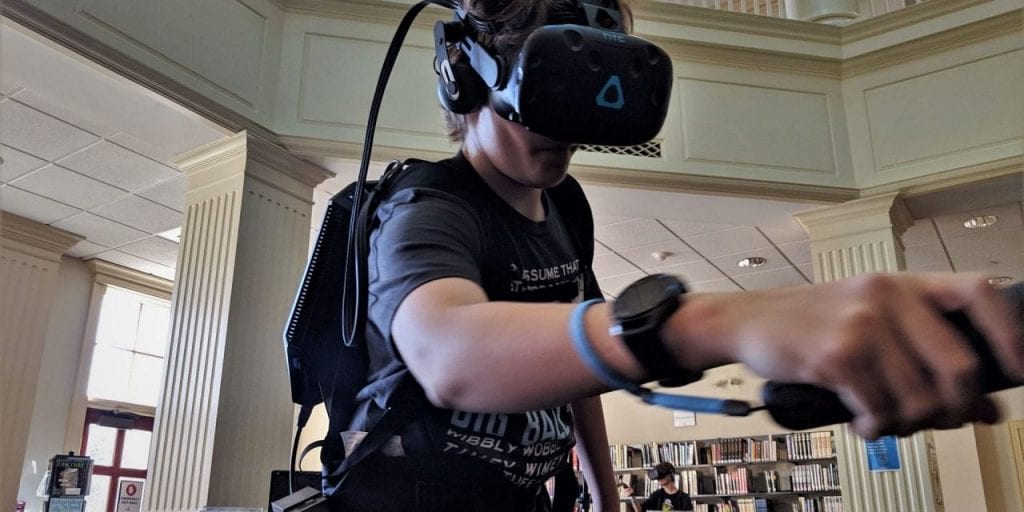
Virtual reality returned this year with different experiences for each day of the week. Users have shot a bow and arrow, helped R2-D2 fix the Millennium Falcon, avoided spaceship fire, or sliced fruit with a Samurai sword. A fan favorite will be chosen for Friday’s experience.

This year also saw the addition of more items and games, including a Microsoft HoloLens Scavenger Hunt in the library. Librarian Brian Pugsley placed holograms all around the first floor of the library for scavengers to discover. Participants who find the most by the end of the week will win a Merge AR Cube, an augmented reality toy that allows you to hold holograms in your hand.

Another new activity this year is a traditional 1000-piece jigsaw puzzle featuring Georges Seurat’s painting A Sunday Afternoon on the Island of La Grande Jatte (1884–1886). Famous for his innovative methods and techniques, Seurat used logical abstraction and mathematical precision to construct his paintings. He, along with artist Paul Signac, is credited for inventing a painting technique called pointillism, which relies on the viewer’s eye and brain to blur and blend many small dots together into a fuller range of tones that create an image. Pointillism led the way for image rendering and is the foundation for how computer screens work.

WISE strives to promote and support women in science and engineering while creating a collaborative and social academic environment for all. To that end, the week will culminate with a WISE-sponsored event for all Middle School students this Saturday in the Discovery Studio. Students will have the opportunity to participate in a variety of STEM-related activities outside of the classroom, including working with liquid nitrogen alongside an NC State engineering professor, learning statistics from jellyfish, computational thinking games, and virtual reality.

Computer science and the principles of computational thinking are in everything that we do. During Computer Science Week, we strive to provide all types of activities showcasing this fact, many of which do not involve a computer at all. This year, one of the biggest hits with the community has been a hanging balancing puzzle game called Suspend. Another fan favorite, back from last year, is Mindbender Origami.

Personally, Computer Science Week is my department’s favorite week of the year. We’re sad to see it come to an end, but have already started thinking about what next year will bring.

Written by Karen McKenzie, Director of Innovation & Technology

Athletics

2020 Spring Athletic Awards

USAYPT Claims Top Spot in Prestigious National Tournament

6th

CA Science Olympiad Success!

Library from quad

CA’s Speech and Debate team takes top honors at the Pinecrest Open 

October 4, 2018

Congratulations to CA’s Speech and Debate team for taking top prize at the Pinecrest Open at Pinecrest High School in Southern Pines, NC on September 29.  Students participated in Original Oratory, Extemporaneous Speaking, Program Oral Interpretation, Impromptu Speaking, Lincoln Douglas Debate, Public Forum Debate, and Congressional Debate. CA placed in every event in which we participated.


Team: First place – Overall Sweepstakes


Bayla Sheshadri: First place – Original Oratory

Becca Segal: First place – Impromptu Speaking

Lexi Klein: First place – Varsity Congressional Debate

Sydney Tai:  Best Declamation and all-around Declamation Champion

Grace Wissink: First place – Program Oral Interpretation

Emily Zheng: Sixth place – Declamation

Becca Segal: Fourth place – Extemporaneous Speaking 

Shannon Jenkins: Fourth place – Varsity Lincoln Douglas Debate

Will Aarons: Fifth place – Varsity Lincoln Douglas Debate

Isaac Fan and Matthew Schaefer: Fifth place – Varsity Public Forum Debate


An extra congratulations to our debate novices on an impressive showing at their first competitive tournament.


Folu Ogundipe: Second place – Novice Lincoln Douglas Debate

Emily Wang: Third place – Novice Lincoln Douglas Debate

Allie Chandler: Fourth place – Novice Lincoln Douglas Debate

Casey Powell: Sixth place – Novice Lincoln Douglas Debate   

Safiya Alvi, Owen Kadis, Maddi Macchi, Allen He: Honorable mentions – Novice Lincoln Douglas Debate


Alek Palakuruthi and Aryan Nair: Second place team – Novice Public Forum Debate

Adam Farris and David Howard: Third place team – Novice Public Forum Debate

Miles Ramee and Sanjna Jotwani: Fifth place team — Novice Public Forum Debate

Andrew Holland and Oliver Moore; Annya Sachdeva and JR Cobb: Honorable mentions – Novice Public Forum Debate


Meirav Solomon Fourth place – Novice Congressional Debate

Andrew Lake: Fourth place – Novice Congressional Debate

Jane Sihm: Fifth place – Novice Congressional Debate

Kelsey Welch: Sixth place – Novice Congressional Debate

Written by

MS SciOly team scores their highest finish ever

Science In Action

Upper School

Cary Academy students honored as Catalysts for Change

Library from quad

Juniors take second in biomedical debate

March 26, 2018

This weekend, 11 CA students traveled with advisor Troy Weaver to Greensboro for the 43rd NC State Health Occupations Students of America (NC-HOSA) State Conference and competition. 

Five of those students advanced to the final round of competition, a first for Cary Academy. Salma Said ('19), Anthony Guzzo ('19) and RJ Jain ('19) made it to the final round of team Biomedical Debate.  Cindy Li ('20) and Christianna Swift ('20) made it to the competitive finals of CERT and were presented with a relief scenario in which they will be judged on the medical applications they employ in a mock disaster.

The team of Said, Guzzo, and Jain took second after the final rounds, and as a top-three finisher will represent North Carolina at the International Leadership Conference on June 27th-30th in Dallas, TX.

Written by

Cary Academy Speech & Debate Delivers Historic Season of Success

This year’s all-school, extracurricular theater production is under construction

CA’s largest-ever Model UN team makes strong showing at conference

Library from quad

Sci Oly team takes medals

February 6, 2018

Congratulations to the 36 US students who competed in the Science Olympiad Raleigh Regional. Our JV team medaled in eight events and the Varsity team earned 5th place and medaled in 12 events

Written by

History

National History Day successes

CA Curious

CA Parent/Caregiver Learning Series

CA Curious

Making the connection (from a safe distance)

Library from quad

Physics team shoots for the moon

February 2, 2018

Cary Academy took 3rd place in the prestigious United States Invitational Young Physicists Tournament (USIYPT) in January 2018. Teams of students from schools around the world had been working on complex problems for a full calendar year and joined together to share and defend their research. 

This year, teams of students worked on Moon’s Orbit (Robert Schellenberger and Vincent Wang with help from Rachel May and Abe Weinstein), Electromagnetically Coupled Mechanical Oscillators (Cameron Fisher and Abe Weinstein with help from Obinna Modilim), Projectile Motion Through the Air (Josh Pullen, Ross Matton and Ben Humphries with help from Scott Matton, Will Aarons, Felipe Chiavegatto, Aidan Sher, and Saajan Patal) and Incandescent Light Bulbs and Blackbody Radiation (Maggie Hayes with help from Christian Sodano and Paul Ibrahim).    

The competition on these undergraduate-level physics questions involves both presentation and defense of CA team research but also understanding and discussing the research presented by other schools.  Maggie Hayes (team captain), Robert Schellenerger, Josh Pullen and Abe Weinstein ably presented and defended their work at the competition, but it is truly an effort of the whole group, as no single person could possibly complete a project of this magnitude alone.

USAYPT’s goal is to improve teaching and learning by promoting research at the high school level.  This was the third year that Cary Academy has been invited to participate. The team was started by US physics teacher Matt Greenwolfe, with support from faculty members Dick Mentock, Robert Coven, and Rachel Atay.  

Written by

Athletics

Charger earns a spot on national table tennis team

CA Curious

Meet the New Faces of CA

Magazine of CA

Character Construction

Library from quad

Both JV robot teams headed to States

January 30, 2018

Cary Academy has two JV robotics teams that compete in the FIRST Tech Challenge. On Saturday, January 27th, they went to their second qualifying tournament, their last chance to move on to the States. Both teams (and robots) met the challenge with flying colors.

At the end of round-robin play where each team competes in 5 matches, both Team Q – 5270 and the ChargerBots – 12010 finished with records of 4-1. Scoring rules sort out ties leaving 5270 seeded #3 and 12010 seeded #4. The #1 seeded team was Aperture Science, driving a virtually unbeatable bot; and Deus Ex Machina rounded out the top for as the #2 seed.

During alliance selection, where the top 4 seeds choose two other robots to join their alliance, the #1 team chose 12010 to join them and the #2 seed chose the 5270 to join them. Both CA teams jumped to a higher-seeded alliance, opening the door for our teams to go head-to-head in the finals. 

Playoff rounds use a best two out of three format, and both alliances won their semi-final rounds in two matches, sending both CA teams to the finals, on opposing alliances. Seeding held true to form as the #1 alliance claimed the victory in two matches.

Thus, CA’s Chargerbots (12010) arrived home with a champion trophy. They also earned the Connect Award, recognizing their work to reach out to the community and share robot love.

Not to be outdone, Team Q (5270) came home with not only the runner-up trophy, but also with the Control Award, which recognizes excellent programming systems.

It was an awesome day for CA robotics and the teams now have 2 weeks to get ready for the State Championship on Feb 10th in Greensboro.

Join us in congratulating the members of CA’s JV Robotics teams:

5270 – Team Q
1. John Kesler (10)
2. Matthew Modi (10)
3. Sheridan Page (10)
4. Myla James (9)
5. Zariah Greene (10)
6. Casey Cervenka (9)
7. Quinn Vaughan (9)
8. Ryan Chen (9)
9. Jono Jenkens (10)
10. Evan Snively (10)
11. Loren Troan (10)
12. Han Zhang (9)
13. Brandon Yi (9)
14. Morgan White (10)

12010 – ChargerBots
1. Scott Matton (10)
2. Felipe Chiavegatto (10)
3. Ethan Norfleet (10)
4. Colin Zhu (10)
5. Harrison Truscott (9)
6. Aidan Sher (10)
7. Sachin Amaresh (10)
8. Sarah Hallman (9)
9. Olivia Zimmerman (9)
10. Anisha Rustogi (9)
11. Zach Wiebe (9)
12. Anna Cheng (10)
13. Obinna Modilim (10)

Written by

Latest News

CA Launches Digital Viewbook

Athletics

Middle School track teams take CAMSC championship by storm

Magazine of CA

SPOTLIGHT ON AI