fbpx

Donor Stories

Promise Made Possible

January 12, 2026

Cary Academy is setting a new standard for access and affordability in independent education. Introducing Charger Promise—free tuition for families earning $100,000 or less, with significant, scaled support extending far beyond that. 

Grounded in our founding values and propelled by an alum whose own CA beginning transformed her future, Charger Promise is more than an enhancement to financial aid. It marks a defining moment in CA’s evolution, a bold affirmation that excellence and access belong together, and that our future is brightest when more students can step fully into it. 

Charger Promise makes CA both imaginable and attainable for families who might not have otherwise considered an independent school. For students receiving assistance, it removes barriers to full participation in school life, from debate tournaments to artistic projects to prom tickets. And across the CA community, classrooms, conversations, performances, and programs are enriched by the inclusion of a broader range of voices and experiences. 

A founding value 

It also reaffirms a truth that has guided Cary Academy since its earliest days. Founding visionaries Dr. Jim and Ann Goodnight and John and Ginger Sall believed that an exceptional education should be accessible to all qualified students, regardless of financial circumstance. For nearly three decades, the school has lived that belief, providing substantial financial assistance across a wide range of economic profiles. Last year alone, CA awarded $3.1 million in financial aid, meeting 100% of demonstrated need for 128 families. 

Endowed funds from the Goodnights continue to underwrite much of CA’s financial aid. Believed to be the first initiative of its kind for independent schools in the Southeast, Charger Promise builds on that base, adding new resources to expand opportunity for the next generation of Chargers.  

Opening doors 

Fittingly, one of the people helping drive Charger Promise is someone who once entered CA through financial aid herself—and whose life was transformed because of it. 

Holly May, ’05, didn’t set out to become an entrepreneur, a nonprofit founder, or the philanthropic spark behind Charger Promise. But her experiences at Cary Academy and the possibilities they unlocked shaped every step that followed. 

“CA opened my eyes to possibilities I hadn’t dared imagine,” Holly reflects. “My potential wasn’t just noticed; it mattered and was nurtured. That kind of belief stays with you long after you leave.” 

Over the years, Holly and her husband, Travis May, ’05, a fellow alum, have kept CA close (so close, in fact, that they were married on the Quad). As longtime, engaged alumni, and through Holly’s service on the Board of Directors, they have championed broader access for future Chargers. Their gifts have helped move a long-standing aspiration into launch-ready reality, extending the same transformative opportunity Holly once received to the Chargers who will follow. 

Visionary impact 

Holly’s story offers a powerful lens into what Charger Promise represents: the transformative impact of access and the responsibility to extend it forward. 

When Holly arrived at CA as a sixth grader supported by financial aid, she stepped into a community that pushed, stretched, challenged, and believed in her. In her words, CA was “the delta”—the turning point—in her life. The catalyst that reshaped her sense of what was possible. 

Her path since—spanning entrepreneurship, nonprofit work, and philanthropy—reflects a throughline of curiosity, purpose, and commitment to opening doors for others. 

In 2025, Holly founded Exponential Scholars, a nonprofit organization dedicated to expanding access to transformative educational experiences for underrepresented youth in North Carolina. Through scholarships, mentoring, and enrichment opportunities, the organization mirrors the values that shaped her own life—the same values that drive Charger Promise. 

“Potential is everywhere, yet life-changing opportunity is not,” Holly says. “And when you clear the barriers that stand in the way—whether at CA or in communities across North Carolina—you can dramatically change the course of a young person’s life.” 

That alignment of mission and personal experience made supporting Charger Promise especially meaningful. 

“When CA started rethinking what affordability could look like, it resonated with me,” she says. “This place shaped who I became; it changed my life. Opening that door for others just felt right.” 

Promise to possibility 

When asked what she hopes this initiative communicates, Holly is clear: “Possibility. More than anything, I want families across the Triangle to feel that CA is truly accessible to them. That they can belong here and thrive and unlock their child’s potential.” 

Her words echo what her own teachers once saw in her. They also capture the purpose of Charger Promise: not simply to assist families, but to expand who gets to imagine themselves here—and to broaden the futures shaped by Cary Academy students. 

For Holly, it is a full-circle moment. For CA, it is a strategic milestone. And for the students who will walk through the door thanks to this initiative, it marks the beginning of futures that might once have felt unattainable.

A new model for access 

Quietly piloted last year for admitted families, the expanded Charger Promise is now open to both new and returning Chargers for the 2026–2027 academic year. 

Under the expanded financial assistance program:

• Families with a combined household income of $100,000* or less will pay no cost to attend Cary Academy, including free tuition, dining, transportation, and before-care and extended-day programs. *assumes asset profile consistent with income

• Families with a diverse range of economic profiles above that threshold qualify for reductions covering anywhere from 54–95% of the cost of attendance. 

• Supplementary Discovery Stipends provide all students receiving financial assistance with support for non-tuition expenses that might otherwise limit participation (e.g., academic competitions, global learning excursions, tutoring, enrichment programs, athletic gear, specialized activities, etc.) 

Mission in action

Charger Promise is one of the first public expressions of Cary Academy’s new strategic plan, one grounded in cultivating a learning community where purpose thrives, opportunity is accessible, and wellness and equity are foundational. 

“Affordability isn’t just a financial question,” Head of School Dr. Mike Ehrhardt notes. “It’s a values question. It asks: Who can be here? Who feels welcome? Whose potential are we committed to nurturing? 

“With Charger Promise, we’re proving that excellence and equity can, and must, go hand in hand. It’s our mission in action—an expression of who we are and who we aspire to be.” 

CA’s commitment to access and affordability extends well beyond this initiative. It shows up in robust student support systems, intentional access to experiential and real-world learning, transportation solutions that connect more families to campus, and curricular pathways that honor student agency and purpose. 

Together, these efforts point toward a future in which access is not an aspirational goal, but a defining feature of the CA experience. 

“We talk often about preparing students to shape the future,” says Ehrhardt. “For that to ring true, the opportunity to be here—to learn, to grow, to discover purpose—must be within reach. Charger Promise helps make that possible.” 

Written by Mandy Dailey, Director of Communications

Athletics

Chargers Shine at XC State Championships

Faculty Reflections

Faculty Conversations: Social and Emotional Health

A strong season for speech and debate

Latest News

­Cary Academy Announces Charger Promise­

December 11, 2025

Groundbreaking initiative expands access and affordability in independent education in the Triangle with full cost-of-attandance coverage for families earning $100,000 or less

Cary, NC, December 11, 2025 — Cary Academy is taking a bold step to redefine access and affordability in independent education. Through its expanded Charger Promise initiative, the school will now provide 100% coverage of the full cost of attendance—including tuition, dining, transportation, before-care, and extended-day programs—for families with a combined household income of $100,000 or less*.

In addition, Cary Academy will offer scalable, need-based support for a wide range of family income profiles above that threshold, with 50% to 95% of the cost of attendance covered, depending on individual circumstances. Together, these enhancements mark what is believed to be the most comprehensive affordability initiative of its kind among independent schools in the Southeast.

Launched quietly last year, Charger Promise has further expanded in the 2026–2027 academic year, for which applications are currently open.

“Access to an exceptional education shouldn’t depend on a family’s financial means,” said Dr. Mike Ehrhardt, Head of School. “Charger Promise is a tangible expression of our strategic commitments to expanding access and opportunity. We’re redefining what affordability looks like in independent education and proving that excellence and equity can—and must—go hand in hand.”

Charger Promise is made possible through the leadership support and contributions of Holly and Travis May, both alumni of the Class of 2005, and long-time supporters of Cary Academy’s commitment to expanding socio-economic diversity. In 2025, Holly May founded Exponential Scholars, a nonprofit that creates life-changing opportunities for gifted youth in underserved North Carolina communities.

“As a Cary Academy student coming from rural Chatham County, I needed and benefited from financial assistance. I know firsthand how transformative this school can be,” said Holly May. “Cary Academy was the delta in the trajectory of my life. Through Charger Promise, we hope to open that same door of possibility for other students whose potential should never be limited by circumstance.”

Cary Academy has long been committed to alleviating the financial burden of independent school education. Last year, the school awarded more than $3.1 million in need-based financial aid, meeting 100% of demonstrated need for 128 students.

The expanded program builds on this foundation by addressing not only tuition but the broader costs of participation. All students receiving financial assistance also have access to Discovery Stipends—annual grants designed to remove barriers to deeper engagement and exploration. Stipends range from $500 to $1,500 for Upper School students, and up to $300 for Middle School students, supporting non-tuition expenses such as academic competitions, specialized activities, or enrichment opportunities.

Taken together, Charger Promise and the new Discovery Stipends ensure that every eligible student can access the full spectrum of opportunities that define a Cary Academy education.

For more information about Cary Academy and its affordability initiatives, visit www.caryacademy.org/withinreach.

*Assumes asset profile consistent with that income level.


About Cary Academy

Founded in 1996, Cary Academy is a learning community for grades 6–12 dedicated to discovery, innovation, collaboration, and excellence—preparing students not only to meet the future but to shape it boldly. Guided by its community values of respect, integrity, collaboration, and equity, the school cultivates a learning environment where purpose thrives, opportunity is accessible to all, and wellness and equity are foundational.

Written by Mandy Dailey, Director of Communications

CA Curious

Welcome to the 25th Anniversary Year at Cary Academy!

CA Curious

Variety in virtual learning

CA Curious

Beyond the numbers

Latest News

Cary Academy Launches Digital Viewbook

January 22, 2025

Cary Academy is excited to unveil our new digital viewbook. Made with future Chargers in mind, it’s all about giving you a peek into what makes CA unique—our innovative and purpose-driven learning approach, inclusive community, and endless ways to explore your interests.

The viewbook is a robust, self-guided experience. Future students and their families can chart a course based on areas of interest or follow one of several student guides to learn more about potential paths at CA.

“There’s no one-size-fits-all here, and that’s what makes CA so exciting,” shares Mandy Dailey, Director of Communications. “We wanted our new digital viewbook to feel as dynamic and personal as the CA journey itself—a place where you can embrace self-discovery and explore what’s meaningful to you.”

Explore the viewbook here.

Written by Joe Lavender

Upper School

A Strong Start to an Inaugural Season

CA Curious

Flex Day Vastly Expands Our Options at CA

CA Curious

Together… at a Distance

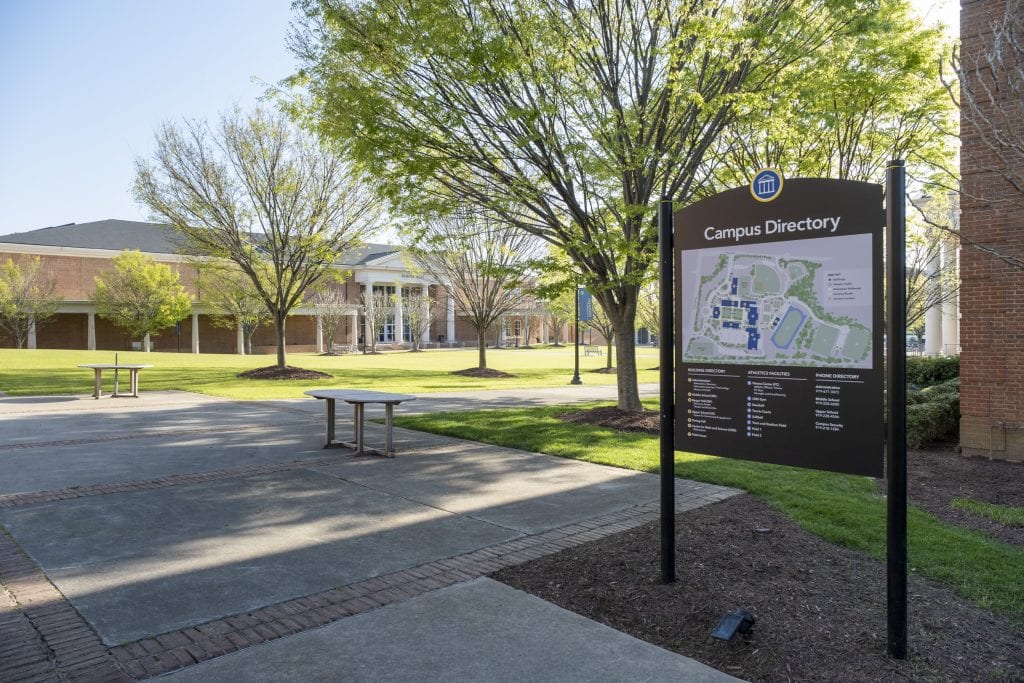
Campus directory on CA quad

CA Curious

Making the connection (from a safe distance)

April 8, 2021

Have you ever bought a house sight unseen? Purchased a car without taking a test drive? This intrepid investing is exactly what independent schools called upon this admissions season.  Finding ourselves in the unique dichotomy of stronger interest than ever, with less opportunity to authentically connect with prospective families, CA’s admissions team called upon our mission and our learning community to help us.    

It is no surprise that the pandemic has created a surge in interest in independent schools.  But just how much of an increase? The National Association of Independent Schools just released their admissions snapshot – a quick way to check admissions and enrollment trends across the country and in regional areas.  Across the country, 60% of schools reported increases in their application numbers; in the southeast, that percentage was slightly higher. While it seems that the elementary years saw the biggest increases in applications across the board, CA’s uptick in applications was especially felt in our non-traditional entry grades of 7,8,10, and 11.   

How did we respond to the challenge of higher interest with limited ability to connect? Last May I wrote about how CA’s balance of mission consistency and institutional flexibility empowered us through these unique times to prepare the best possible program for our students.  The same held true with our admissions work this year.  

With the support of the entire learning community, we revised our outreach efforts to highlight different aspects of our mission-centered program. All events were offered live, and in most cases, recorded, so families could curate their own series of admissions events in a way that worked with their schedules.  

Campus tours went virtual, with parent and student ambassadors using our interactive campus map to connect with small groups via Zoom. Our series of Charger Chats–focused each week on a particular unique aspect of our learning community–went live at lunchtime once a week from late September to early December. These events each closed a Q&A session with current students and parents. Shadow days morphed into virtual mini-classes, where perspective students had the opportunity not just to watch a class, but to take one, led by a CA teacher. Of course, our interviews were also held via Zoom.   Through all of this, prospective students and their families had an opportunity to e-assess CA and determine if we were the right choice for them.   

In the end, we all know there is nothing like walking on campus and seeing the good work that makes up each day at CA. Spring break offered a unique opportunity for us this year; with the faculty and students off campus, we were able to invite our admitted students to visit in-person. More than 300 people came through in eight different sessions. A campus scavenger hunt highlighted student work and our state-of-art facilities in a socially-distanced way and staff members were on hand to offer navigation guidance and to speak to their own experiences as a member of our learning community.     

All these efforts, combined with another year of chart-topping retention, have once again placed CA in a position of strong enrollment as we look toward the 2021-22 school year.   

Undeniably, it would have been impossible for the admissions team to do all this alone. Our sincere gratitude goes out to all the parent and student ambassadors who offered tours and answered questions. You provided invaluable connection and insights. To the staff who helped facilitate events and the teachers, who offered more than 50 mission-focused prospective student classes during free periods, our thanks to you as well.  

Although the process looked very different this year, we have a tremendous group of new Chargers ready to join us in August and take advantage of all CA has to offer.     

Written by Heather Clarkson, Director of Admissions and Financial Aid

Athletics

Varsity Track and Field Wrap Historic Seasons

Faculty Reflections

Founding vision

CA Curious

Gravel Road Lessons: The Serendipity of an X Day

Cary Academy opening ceremony

CA Curious

Prepared for unprecedented times

May 28, 2020

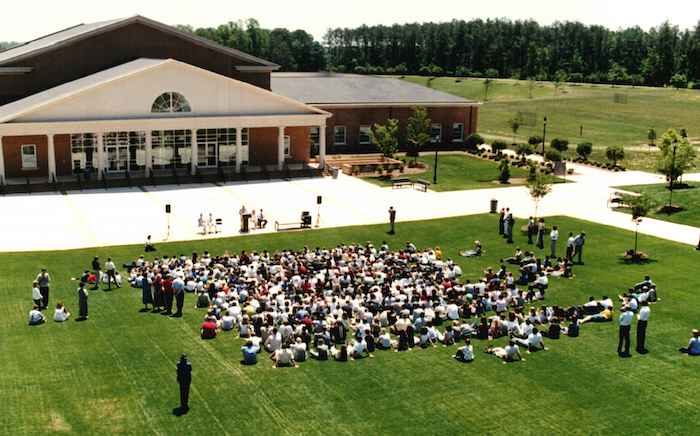
Image: Cary Academy has been preparing for unprecedented times since it’s opening in 1996.

My first role at Cary Academy was as a member of the US English Department. As I have grown as an educator here, and journeyed into other roles, there is one challenge that haunts me in times of stress: finding the right words.  Somewhat ironic for an English teacher, I know.   

Chargers spend a great deal of time in their ELA and English classes discussing an author’s word choice – their diction in a piece. From daily greetings to webinar titles, “unprecedented” seems to be one used quite a bit these days. (I would offer an appropriate synonym; however, “novel” is the most recommended, and that too, gets frequent press these days.)  

In my newest role as Director of Admissions, I am asked regularly how Cary Academy is preparing to open the 2020-21 school year, knowing that learning will continue to “look different.” Will we “be ready” by mid-August?  

Our strong academic program is often the first focus for prospective students and families considering CA, and there are many questions about the ability of an institution to deliver the same caliber of learning when a teacher isn’t physically present with one’s students.   

I admit that the first time I was asked this question, there was a spark of stress.  Mostly because I could not fathom how to abridge the incredible work I have seen occur over these past months into a single soundbite. So, I took a moment to choose my words.   

We are consistent.   

con·​sis·​tent | \ kən-ˈsi-stənt  \ 
1a: marked by harmony, regularity, or steady continuity: free from variation or contradiction (https://www.merriam-webster.com/dictionary/consistent

Cary Academy is consistent in its mission.  

Since the founding of the school in 1996, the words learning community, discovery, innovation, collaboration, and excellence have been the threads woven to create a rich tapestry of educational experiences. A true testament to our founders’ vision for 21st century learning, this one sentence has survived since the days of techo-dinos: the desktop computers. It sets us apart, and we are known for our incredible academics founded on this mission.  

Cary Academy is consistent in its student-centered, reflective practice.  

The heartbeat of Charger Nation is the Chargers themselves. As Cary Academy educators, we continue to reflect upon best practices for our students. We do not rest upon our laurels, rather use success as a springboard into our next wonderings on how to improve.  

Cary Academy is consistent in its focus on professional development of its employees.  

Recognizing that faculty and staff drawn to our mission must be life-long learners, our School’s emphasis on professional learning is unparalleled.  This could not be more evident than in the work our faculty will embark upon this summer, as they take three weeks (from their vacation) to best prepare for the various formats that our schooling will take next year.    

Consistency is an attribute, no doubt.  Yet as the parable of the oak tree and the reed demonstrates, consistency alone does not stand the test of time or the storms it brings. We must be able to bend when needed.  Thus, my second word.  

We are flexible.   

flex·​i·​ble | \ ˈflek-sə-bəl  \ 
3: characterized by a ready capability to adapt to new, different, or changing requirements (https://www.merriam-webster.com/dictionary/flexible

In a time when all schools must be flexibile, Cary Academy has a track record of innovation and adaptation in pedagogy, curriculum, and programs.  While others were forced to this characteristic just months ago, our Mission has mandated it for more than 20 years. 

We have a long record of flexibility in our practices.   

Mr. Follet’s recent email on the Upper School shift to semesters resonated with me. Eight years ago (in the role as Head of Upper School), I posted a similar letter informing parents and students that we would no longer hold an exam week.  

In both cases, our student-centered, data-driven decisions took into consideration best practices and student wellness. In the years between these two epistles, both divisions have shifted schedules, adapted assessment practices and opened entire departments (the Center for Community Engagement). As appropriate, we have embraced blended, online, synchronous and asynchronous learning, to name just a few.   

We maintain flexible rigor.   

Even before our strategic goal of relevant, personalized, and flexible learning opportunities was published, our academic departments have proposed bold shifts in our curricular offerings.  

The recent curricular review cycle resulted in a menu of course offerings that respond to student interest and aptitude – elective offerings science, English, world language and PE reflect this work. Our unique world history elective program for 9th and 10th graders predated these changes, and our arts department have been embracing the myriad opportunities of aesthetic, design and ensemble instruction since the start of the school. With 46 advanced classes, 20+ levels of math instruction from grades 6-12, and countless electives, students are authentically engaged where they are on their path of learning.  

But students are not just scholars. They are citizens, friends, individuals whose social and emotional growth is equally important.  

We flex to the immediate needs of our students wellness.   

In my many years serving as an Upper School advisor, faculty leaders have spearheaded timely curriculum renewal of our affective education program.  From Charger Trails in the Middle School to social media literacy curriculum in the Upper School advisory program, we are constantly molding our program to meet our students’ needs and to address the challenges they face as young people.   

A leader in diversity and inclusion work, Cary Academy is one of the first schools in the National Association of Independent Schools (NAIS) to launch an affinity group program. And our work with Essential Partners on Dialogue Across Differences underscores even more our commitment to each student being seen, heard, and known for who they are.   

And this list isn’t even exhaustive of how education “looks different” at Cary Academy.   

So, when I now get the question focusing on this fall, I offer this: 

Since the opening of the school, Cary Academy has embraced the opportunities of being both consistent and flexible in our program. We have been preparing for the past 24 years for a challenging opportunity such as the one facing us in these unprecedented times. We’ll continue to lean into our mission, our strengths, just as we always have. 

Yes, we’ve got thisWe will be ready 

Written by Heather Clarkson, Director of Admissions and Financial Aid

Alumni Spotlight

Re-working the System

CA Curious

Emotional Nutrition

6th

First MS Community Day of the Year

TISC Meeting

Events

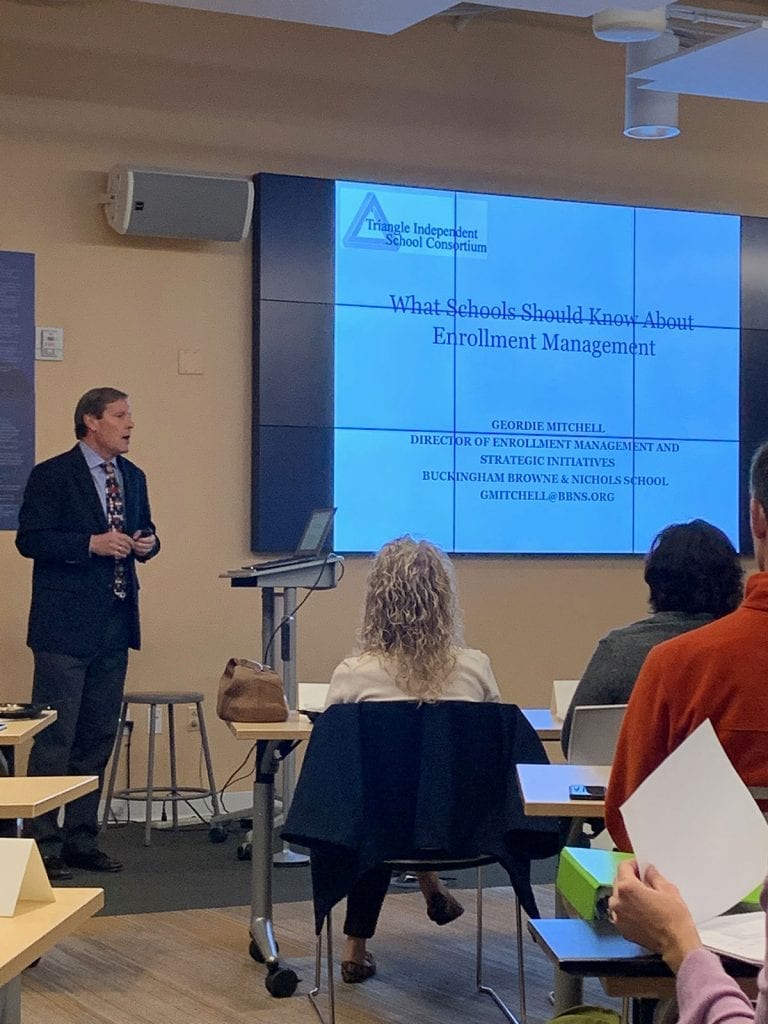
Cary Academy hosts TISC meeting on enrollment trends

November 22, 2019

This morning, Cary Academy hosts the Triangle Independent School Consortium, bringing together Heads of School and Admissions Officers from 18 schools in the Triangle to discuss trends in enrollment management.  International presenter and content specialist Geordie Mitchell, Director of Enrollment Management and Strategic Initiatives at Buckingham Browne and Nichols School, presented.

Written by

Upper School

A Strong Start to an Inaugural Season

Upper School

Student’s voice earns national recognition

Events

Chargers Strike Gold on the Water

CA Students sitting on the Quad

CA Curious

Great Tour Guides Don’t Walk Backward Anymore

October 3, 2019

I wasn’t destined to be a tour guide.  For both my independent high school and undergrad college communities, I lacked the prerequisite skill of walking backward while talking.  I always envied those who could, as meeting new people and talking about my school were both activities I enjoyed.  Perhaps that is why I started my career in the classroom – teachers walk around the classroom, but hardly ever backward, and sometimes we get to stand still!

Of course, the world of admissions has taken on an entirely new landscape – one in which the skill of building connections and introducing possibilities has become the new preferred method of traversing campus.  We walk alongside our prospective families hearing their hopes and dreams for their student while sharing experiences, insights and vision of our learning communities. I expect that this was your own experience when you first visited CA, where a parent or student ambassador lead your tour of campus.

Along with tours, the decision-making process for families has evolved quite a bit as well.  My high school was selected by my parents, as I was a third-generation legacy student.  More and more, parents and students are truly comparative consumers – seeking the school that will match their unique combination of academic and extracurricular interests, wellbeing priorities, and future aspirations.

This shift in school selection philosophy has been the subject of research at the college and university level as well.  It’s even been named: Prospective Student Decision Theory.  In short, students determine the school they want to attend through four critical experiences: the interaction with the first person they meet on campus, their assessment of the variety of academic and extracurricular activities available; their ability to “see themselves” in the community; and how regularly they think about the school after visiting.   

In other words, we’re definitely not walking backward anymore! 

Seeking to offer prospective students and their families with an experience on our campus that offers this type of engagement, we’re launching our first immersive open house: Experience CA Day. 

On Saturday, November 2, from nine to eleven in the morning, our campus will be open for visitors to classrooms, see student projects, and engage with teachers.  There will be ongoing performances in Berger Hall, affinity group discussions in the dining hall, and practices in the maker spaces.  Think robots shooting hoops, slideshows highlighting trips, and all the organic, deeply meaningful conversations that happen along the way. 

There will also be food trucks and swag scavenger hunts – after all, this is a CA event! 

It’s certain to be a phenomenal celebration, where guests can choose the areas they would like to focus on while CA students, staff and PTAA share all that learning community has to offer.  

Our thanks goes out in advance to all community members who will be sharing their time and talents in support of this event. These are the forward-moving ambassadors who are taking CA into the future.

Where we need the most help is sharing the invitation! Please encourage family, friends, colleagues, neighbors, or any others you know who may be interested in CA to attend, and please like the FB event!

Information and registration is available on our Admissions Events page.

Written by Heather Clarkson, Director of Admissions and Financial Aid

CA Curious

Change, resilience, and kindness

Athletics

Charger earns a spot on national table tennis team

Community

Student service, affinity groups make news

Lex-Jordan Ibegbu (‘08) Alumni

Alumni Spotlight

College Chronicles: Lex-Jordan Ibegbu (‘08) University Of North Carolina At Chapel Hill & University Of Miami Law School

August 16, 2019

Vision, ambition, and will

Lex-Jordan Ibegbu transferred into CA from public school his freshman year.
“College choice is all about what you are exposed to,” Ibegbu explains. “Prior to CA, I didn’t really know what college I wanted to go to. I had always assumed I’d go to Shaw University. My parents attended Shaw University. I grew up across the street.”

Over the course of his four years at CA, however, his horizons broadened, with the University of North Carolina at Chapel Hill rising to near-mythical status in his mind.

“I had never been to Chapel Hill. I didn’t know anyone that attended Carolina” says Ibegbu. “But, CA was sending a lot of students to Carolina. I researched and discovered the kind of professionals that Carolina was producing. I wanted to be an attorney and I knew that Carolina had a strong political science department. I also knew that the Carolina name would open doors for me later in my career. Going there became one of my prayers.”

The transition to CA had been an academic adjustment, but one that he was able to manage after a year. Still, some thought Carolina might be a reach for Ibegbu. He credits his mother and college counselor Laura Sellers for believing in him enough to encourage him to pursue his dream and apply.

“Ms. Sellers was such a blessing. She told me exactly what I needed to do to make it happen. I took the SAT twice to attain a sufficient score” Ibegbu recalls. “I only needed to see the blueprint. Once I learned the process I could then apply it. I believed in myself. I believed in my spirit that I would go to Carolina.”
With clear goals, guideposts, and a healthy boost of confidence, Ibegbu threw himself into the application process, while also pursuing scholarship options. His clear-eyed tenacity was rewarded, and he was admitted to Carolina on a full scholarship as a Covenant Scholar.

As an African American student in a then-predominantly white CA community, the promise of Carolina’s diverse student body had also been a tremendous lure to Ibegbu. On campus, he took full advantage, immersing himself into academic, social, and extracurricular experiences through which he weaved a broad social network that would pay dividends throughout his college career and beyond.

His eyes set on law school, Ibegbu pursued a degree in political science. He also continued the student government work he’d enjoyed at CA and was elected as a student body congressman. It was an experience that afforded the opportunity to collaborate with an ever-widening circle of students, while also providing practical experience that he could leverage for law school.

He pursued his other passions—music and drama—via dual minors. A rapper, Ibegbu used his music as a networking tool, performing for various student groups across campus and always making connections along the way.

“I credit Carolina with teaching me how to maneuver in different environments,” offers Ibegbu. “Every week I tried to connect with people from different insular communities throughout the campus. That might have been going to plays with my drama friends, or performing at events hosted by Lambda Upsilon Lambda Fraternity (a Latino fraternity), or working on legislation with members of the Muslim Student Association, or seeking out mentor opportunities within Carolina’s vast alumni network. I was always consciously trying to broaden my horizons, to build that social capital.”

Ibegbu graduated from Carolina in 2012 and was admitted to the University of Miami School of Law, from which he graduated in 2015. He is now a practicing attorney in both Florida and North Carolina with the law office of Kurtz & Blum, PLLC. He currently has a focus in criminal law, with an eye for music/entertainment issues, and engages in political consultant work for various candidates and politicians.

“As for the future, I am always seeking growth and knowledge. I want to become an immense legal mind, perhaps start my own practice that spans the eastern seaboard. I hope to exercise some influence over this country’s politics and economic policies.”

As always, Ibegbu is making a plan and charting a course for success: “I am setting the foundation for my dreams and working towards creating a lasting legacy.”

Written by Mandy Dailey, Director of Communications

Faculty Reflections

Death rays & grains of sand: The sweet science of a physics fight

Magazine of CA

Personal Best

Middle School

Parenting expert Michelle Icard to host parent book club chat in January

Andy Walsh (’09)

Alumni Spotlight

College Chronicles: Andy Walsh (’09) North Carolina State University & University Of North Carolina Law School

August 10, 2019

Something to Prove

By his junior year at CA, Andy Walsh was grappling with his future.

An accomplished hockey player, he toyed with the idea of taking a gap year to play competitively. He credits college counselor Laura Sellers, his fellow students, and a newfound passion for political science and law—courtesy of RJ Pellicciotta’s advanced United States government class—with helping to set him on the college track.

“CA helped push me to focus on my educational outcomes and to think broader,” explains Walsh. “My friends were all getting into college and I got to a place where I wanted that for myself, I wanted to be part of a great college experience.”

And what did his ideal experience look like? He knew that he wanted to look at local cost-effective options—those that offered a big school experience, flexible curricula, a strong athletics culture, and competitive sports teams. The University of North Carolina at Chapel Hill and North Carolina State University were obvious choices.

Walsh got into State early action, but Carolina rejected him. “Not even the waitlist,” he laughs. “Initially, it was a little hard to take, but, truthfully, that rejection was one of the best things that has ever happened to me. It made me even more appreciative of the opportunity at State, and it also gave me a little bit of a chip on my shoulder. I wanted to prove that

Carolina missed out by not admitting me.”

Right then and there, Walsh made three goals that would define his undergraduate college experience: to participate in clubs, get academic honors, and get into law school.

On campus, Walsh declared a political science major and immediately joined the club hockey team, a familiar experience that had the added benefit of providing an instant friend group. Wanting to get involved in something that would help with law school admission, he opted for student government, winning his first senate seat his freshman year. It would be the beginning of a student government career that would span all four years and include three senate seats, an appointment to the executive branch, and, ultimately, election as student body president his senior year.

Still, the transition from CA’s small community to the enormous 35,000+ student population was daunting in those early semesters; it didn’t always feel like the right choice. After considering a transfer, he decided instead to “double-down” on what it was that he liked most about State: the traditions of  the university.

“My parents never went to a four-year college, so growing up I didn’t have that immediate allegiance to a school that a lot of other kids did,” he explains. “I always thought that connection, that sense of pride was cool. I wanted to help cultivate those feelings for students that, like me, didn’t have them walking in the door.”

Over the next few years, Walsh oversaw a variety of traditions-driven projects, including getting a living mascot for the athletics department; overseeing the “Coaches’ Corner” project that unveiled statues of retired basketball coaches, including Jim Valvano and Kay Yow; and creating “the brick,” a living scrapbook/guide to State’s traditions that is given to every incoming freshman as an invitation to engage.

On graduating Phi Beta Kappa with honors in 2013, Walsh focused on acquiring work experience in preparation for law school. He interned first at SAS, in the Government Relations Department, before transferring into a full-time position at Smith Anderson, one of the largest firms in North Carolina. His mentors at Smith Anderson encouraged his application to law school and in 2016 he was admitted to the University of North Carolina’s School of Law.

Walsh graduated UNC’s School of Law in 2019 and is currently studying for the bar. He looks forward to stepping into his new role in the Charlotte, NC office of the international law firm Cadwalader where he’ll be working on fund finance and corporate law.

His reflection on ultimately being both a member of the Wolfpack and a Tar Heel? “I think State and Carolina do a really good job of identifying the right people for their campuses. I’m so grateful for that,” Walsh reflects.

“Having been there for grad school, I can say with certainty it would not have been a good fit for me as an undergrad. At State, I had just what I needed and every opportunity to prove myself. If you work hard, there are amazing opportunities that will open to you.”considering a transfer, he decided instead to “double-down” on what it was that he liked most about State: the traditions of the university. “My parents never went to a four-year college, so growing up I didn’t have that immediate allegiance to a school that a lot of other kids did,” he explains. “I always thought that connection, that sense of pride was cool. I wanted to help cultivate those feelings for students that, like me, didn’t have them walking in the door.” Over the next few years, Walsh oversaw a variety of traditions-driven projects, including getting a living mascot for the athletics department; overseeing the “Coaches’ Corner” project that unveiled statues of retired basketball coaches, including Jim Valvano and Kay Yow; and creating “the brick,” a living scrapbook/guide to State’s traditions that is given to every incoming freshman as an invitation to engage. On graduating Phi Beta Kappa with honors in 2013, Walsh focused on acquiring work experience in preparation for law school. He interned first at SAS, in the Government Relations Department, before transferring into a full-time position at Smith Anderson, one of the largest firms in North Carolina. His mentors at Smith Anderson encouraged his application to law school and in 2016 he was admitted to the University of North Carolina’s School of Law. Walsh graduated UNC’s School of Law in 2019 and is currently studying for the bar. He looks forward to stepping into his new role in the Charlotte, NC office of the international law firm Cadwalader where he’ll be working on fund finance and corporate law. His reflection on ultimately being both a member of the Wolfpack and a Tar Heel? “I think State and Carolina do a really good job of identifying the right people for their campuses. I’m so grateful for that,” Walsh reflects. “Having been there for grad school, I can say with certainty it would not have been a good fit for me as an undergrad. At State, I had just what I needed and every opportunity to prove myself. If you work hard, there are amazing opportunities that will open to you.”

Written by Dan Smith, Digital Content Producer and Social Media Manager

Athletics

Chargers Wrap a Record-breaking Year for Athletics

Athletics

Five CA seniors commit to collegiate sports

Latest News

AI Experiential Workshop Series Comes to an Exciting Close