
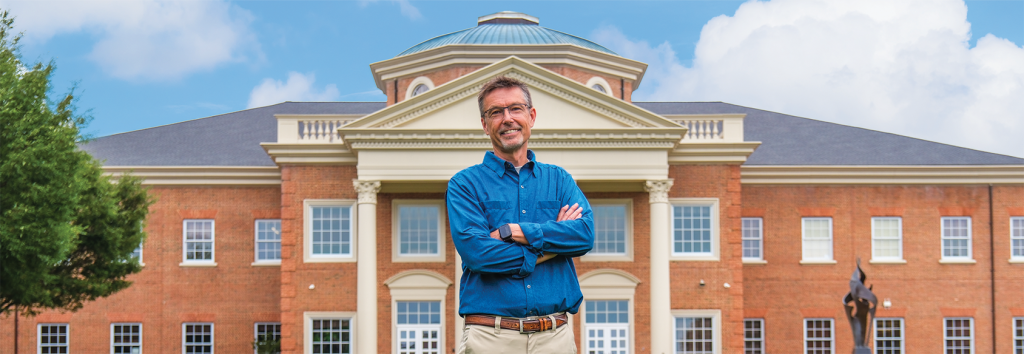
As Cary Academy enters its 30th year, Head of School Dr. Mike Ehrhardt reflects on the unexpected paths, individual transformations, and willingness to keep evolving that have shaped both his life and the school he has led.
Mike Ehrhardt remembers the moment clearly.
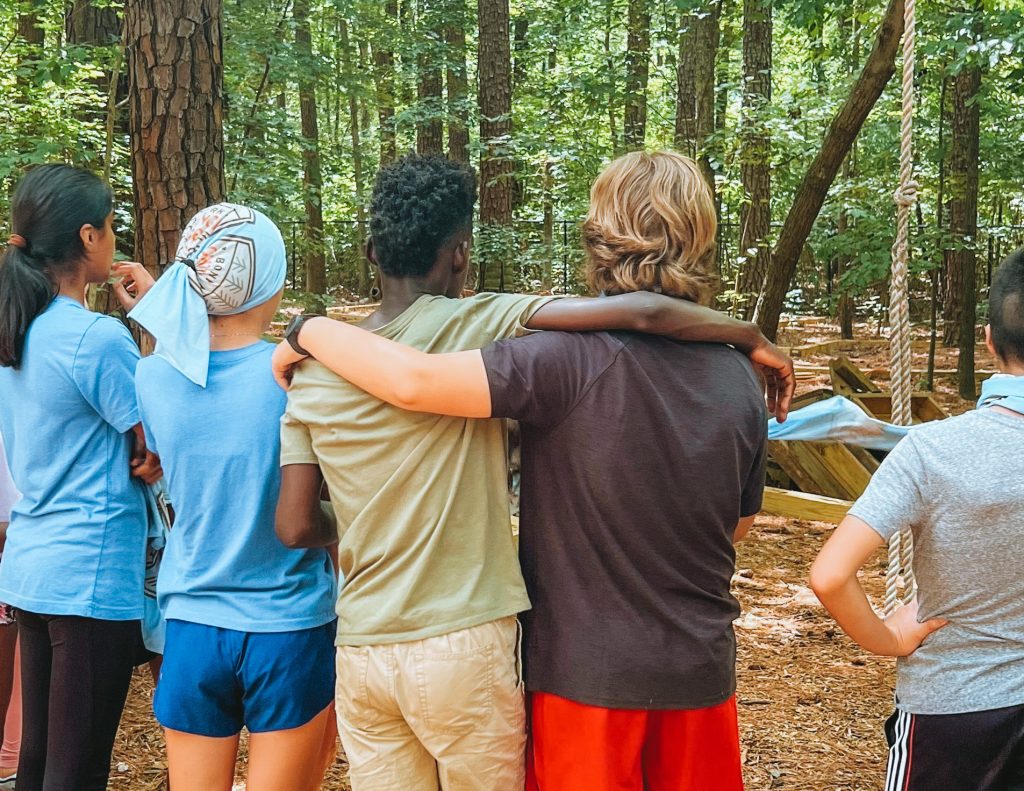
It was early in his tenure at Cary Academy, and he had just returned from an Outdoors Club backpacking trip with a group of students. For one student, it had been her first experience on the trail. The hike had been physically demanding. There had been difficult stretches, but moments of joy, too.
When the bus returned to campus, Ehrhardt watched her walk toward her mother.
“There was a lightness in her step and a smile and joy in her eyes,” he recalled. She was proud of what she had done and eager to share the experience with someone she loved.
It was not an award ceremony or a public achievement—most people would never know it had even happened. Yet for Ehrhardt, the exchange revealed something essential about Cary Academy: the quiet transformation that can occur when a young person accepts a challenge, moves beyond what feels comfortable, and discovers something new within themselves.
“When students are put in positions that are challenging for them, and they overcome those, they feel that pride,” he says. “They see themselves differently, and they want the people they love to see it, too.”
As Cary Academy begins its 30th anniversary year, it is also entering the final chapter of Ehrhardt’s 14-year tenure as Head of School. He will retire at the end of the 2026–2027 academic year, closing a period in which CA has matured significantly without losing its willingness to keep evolving.
At such a milestone, it might be tempting to measure a leader’s tenure through visible accomplishments (and Ehrhardt has many, such as strategic plans adopted, programs launched, facilities built, enrollment strengthened, or initiatives brought to fruition).
Ehrhardt, however, is more likely to begin with one student getting off a bus.
“I love my numbers. I love my trends. I love my big picture and trying to shape a narrative to see where all of this is leading us,” he says. “But at the end of the day, a school is never just the big picture. There are 809 students at Cary Academy this year, and that means 809 distinct journeys. Eight hundred nine young people finding their way, being challenged, discovering who they might become, and what difference they want to make in the world.”
For Ehrhardt, that is where the work ultimately resides. Not in the institution writ large, but in the personal and often unpredictable journeys of the people within it, and in creating a school where they feel supported in saying yes to what might come next.
WITHOUT A MAP
Ehrhardt’s own journey offers an example of the kind of growth CA asks of its students. It was not carefully mapped from the outset, nor was it directed toward a predetermined destination. Instead, it unfolded through curiosity, relationships, unexpected invitations, and a willingness to take risks and even get a little uncomfortable. Growing up in a small town outside Minneapolis, Ehrhardt expected to attend college, but had not yet formed a clear picture of where he belonged or what might follow. That began to change during his senior year, when a new speech and debate coach made an impression on him. Curious about the path that had shaped someone he admired, he asked where she had gone to school. Her answer, St. Olaf College, gave him a place to begin.
He arrived without a fixed career plan, but not without a commitment to avail himself of all the school had to offer. When he and a friend applied to edit the college’s weekly newspaper, Ehrhardt discovered enjoyment in work that was creative but disciplined, collaborative but deadline-driven, and grounded in the satisfaction of producing something tangible.
At the same time, college was widening his world in a more literal sense. Through St. Olaf’s Global Semester Program, Ehrhardt and his later-to-be wife, Krista, spent five months traveling around the world. The experience deepened their interest in other cultures and perspectives and left them open to building a life beyond the United States.
When an opportunity arose to work at an international school, they jumped at the chance. (“We took a flyer on that,” Ehrhardt says with a laugh.)
That leap launched a 17-year adventure overseas—spanning lengthy chapters in Cyprus, Brazil, and England—that would ultimately redirect his career.
His journalism background led naturally into teaching English, history, yearbook, and student newspaper. As desktop publishing began reshaping that work, he moved toward educational technology, then technology leadership and middle school administration.
While working in London, he completed his doctorate through the University of Minnesota without stepping away from his leadership role. His path eventually led to headship. None of it had been laid out
in advance.
“We talk about students nowadays finding comfort in maps and very clear directions,” Ehrhardt shares. “But a lot of the joy and discovery that’s a part of the CA experience comes from getting out of those comfort zones.”
His own path gave him firsthand experience of what Cary Academy asks of students—to try something unfamiliar, remain open to discovery, and trust that a meaningful direction can emerge before every turn is visible. Years later, those same instincts would help draw him to Cary Academy.
A NEW CHAPTER
When Ehrhardt first arrived for a campus visit in 2012, he immediately recognized an institution whose foundational commitments closely aligned with his own.
CA’s belief that technology could positively affect students’ lives resonated with his background as a technology director. Its emphasis on global citizenship and the World Exchange Program connected to a career spent largely in international education. But it was the founders’ commitment to the school that ultimately gave Ehrhardt confidence in its future.
Guided by the clear and ambitious vision of founders Dr. James and Ann Goodnight and John and Ginger Sall, Cary Academy spent its earliest years building a distinctive educational model. It paired academic excellence with social and emotional growth, embraced technology as a powerful tool for learning, and fundamentally reimagined what an independent school could be.
“As a founder, you hope the values and aspirations that shaped a school will endure, but you also know the school cannot stand still,” offers co-founder Ann Goodnight. “Mike has honored Cary Academy’s founding vision while helping it evolve in intentional and meaningful ways. He has been a thoughtful steward of what we hoped the school could become, understanding what was essential to preserve and where CA needed to grow.”
That balance became especially important when Ehrhardt arrived.
A top-down approach had made sense in CA’s earliest years, when nearly every element of the school was still being built and defined.
“Those foundations had to be established. Everything had to be built and put in place, and then you’re going to ride that out for a while to assess what is working and what isn’t,” Ehrhardt said.
The first strategic planning process of his tenure created an opportunity to ask whether the structures that had helped establish CA’s distinctive model were still serving the school as well as they once had. What emerged was a recognition that the institution had inadvertently become “a little bit more rigid than what we should be” in allowing change and innovation to take shape.
ROOM TO EVOLVE
Rather than abandoning the founding model, CA began to evolve it. Under Ehrhardt’s leadership, the school adopted a more distributed approach to innovation, creating space for ideas to emerge from across the institution.
Departments and teachers closest to the student experience were invited to imagine greater flexibility, personalization, and choice. Ehrhardt helped shape the larger vision, ask questions that moved ideas further, and create the conditions for promising ideas to become meaningful opportunities for students.
“That was, I think, a transformative sort of time,” reflects Ehrhardt.
The shift set in motion a decade-long evolution in CA’s curriculum and programming. It also revealed his ability to pair vision with collaboration, a defining quality of his leadership.
“I’ve tried to give people real ownership of their work by encouraging ideas, fostering thoughtful risk-taking, and instilling the confidence to move things forward,” Ehrhardt says. “But I’ve also seen my role as helping shape the larger direction, asking questions that move an idea further and bringing people together around what might be possible.”
Launched in 2018, the Center for Community Engagement grew from that kind of partnership. Ehrhardt helped articulate the vision, invited others to challenge and strengthen it, and, when the moment was right, used the authority of his role to move it from possibility to commitment.
“At some point, you have to be willing to say yes and tip an idea into reality,” Ehrhardt said. “There are moments when only the Head of School can make that commitment on behalf of the institution.”
“Mike has always brought a deep commitment to the mission and a compelling vision for what Cary Academy could become, but he has always understood that vision is strengthened when it is shared,” says Board Chair Dr. Trude Bate.
“He invites people into the work, takes their ideas seriously, and builds the trust that makes collaboration possible. Then, when the time comes, he has the courage and judgment to move the school forward. That balance of vision, trust, collaboration, and decisive leadership has been a defining strength of his tenure.”
GROUNDED IN MISSION
That collaborative approach shaped not only how ideas moved through the institution, but how Cary Academy came to understand innovation itself.
Technology had been one of Cary Academy’s earliest and most visible expressions of innovation. During Ehrhardt’s tenure, innovation came to mean something broader, shaping not only the tools the school embraced but its willingness to experiment, learn, adapt, and revise in response to a changing world.
“We take risks. We say ‘yes’ and try new things,” Ehrhardt offers. “We demonstrate through the organization and through our faculty that sort of trial and error, iteration and improvement we ask our students to engage in.”
That willingness to experiment supported a more personalized educational experience, with greater student voice, choice, and agency in their learning. It also required continued refinement. As opportunities expanded, CA had to clarify pathways and reassure students and families that there was no single “right” version of a successful CA experience.
“There are all sorts of different transcripts and all sorts of different experiences that students are going to have,” he shares, “and they are all going to be able to lead to a lot of really great things in college and beyond.”
But adaptability did not mean change for its own sake. The mission remained the school’s center of gravity, providing continuity even as CA’s understanding of how best to fulfill it evolved to meet the changing needs of its students.
“The understanding of the words of the mission has evolved and morphed as it’s needed to,” says Ehrhardt. “But this school always has been a school that proudly knows and leans into its mission.”
That evolving understanding of the mission is visible not only in CA’s programs and practices, but in the composition and experience of the community itself. Ehrhardt recalls co-founder Ann Goodnight expressing her belief that the school should more fully reflect not simply Cary, but the broader Triangle.
He is proud of the steady progress made toward that aspiration, particularly during the latter half of his tenure. At the 30-year milestone, he sees the strength and breadth of that diverse community as one of CA’s greatest reasons to celebrate.
“Such a diverse community with so many different perspectives all pushing in the same direction for the mission, in an environment that is supportive and caring, is super powerful,” he says.
“Mike has been an essential partner in advancing equity at Cary Academy,” says Danielle Johnson-Webb, Director of Equity and the Center for Community Engagement. “He understood that reflecting the diversity of the broader Triangle was only part of the work. We also had to examine our practices, structures, and culture, and to do the difficult, sometimes reparative work required to ensure that every person in this community felt seen, valued, and able to thrive.
“He also understood that this work should shape how students experience the world beyond CA,” she continues. “Through the Center for Community Engagement, students are invited beyond their own experiences to encounter different perspectives, develop empathy, and engage responsibly with the wider world. Mike’s partnership has helped to sustain both dimensions of that work.”
HEART OF THE WORK
For all the strategic work of leadership, Ehrhardt’s admiration returns repeatedly to the faculty and staff members who create the daily student experience.
“Without a doubt, our faculty and staff see our kids,” he said.
He watched that commitment become particularly visible during the pandemic, when adults carried their own fears, challenges, and responsibilities but continued to show up for students.
Leaders can be one, two, or three steps removed from the moments when transformation occurs, Ehrhardt explains. The essential work happens in classrooms, activities, conversations, and relationships, through adults who remain present and attentive to young people and create environments where students can be themselves, grow, and take risks.
“They have crafted an environment where that beauty can happen,” he said.
“At the end of the day, the commitment of our faculty and staff to that core notion of being an educator is always what’s most inspiring to me.”
Ehrhardt expects to miss those small celebrations, the moments when a student discovers a new interest after weeks of encouragement or when an ordinary act reveals a growing sense of confidence and possibility.
“Being part of a community that celebrates those kinds of moments and that kind of growth, I’ll definitely miss,” he says.
PAST, PRESENT, POSSIBLE
Cary Academy’s 30th anniversary offers a natural opportunity to look back. CA is no longer a young institution trying to prove that its founding ideas can work. It has matured into a school with a strong identity and an established record of educational innovation and excellence.
That deserves acknowledgment.
“Sometimes when we’re in this sort of, ‘Let’s get to the next thing, let’s get to the next thing,’ I do think it’s important to take a beat and say, ‘Hey guys, let’s feel good for just a little bit about what we’ve done,’” Ehrhardt said. “That’s what these milestone moments are meant to be about.”
But neither the anniversary nor his retirement represents a finished state. Both are invitations to recognize what has been built while remaining open to what might come next.
“If we are a school that believes in innovation, believes in the individual, and believes in matching those things to a world that they are going to grow into, then we’re always unfinished,” he said. “We always have to change and adapt.”
Honoring what CA has built does not mean preserving any one version of the school as a golden age. Emerging technologies will bring changes the school cannot yet fully predict. The work of expanding access and affordability is ongoing. New people and a changing world will bring different experiences and questions.
Ehrhardt’s confidence in the future rests not on a particular program or plan, but on those who continue to choose Cary Academy.
“The people that are attracted to come to work and be students and parents at Cary Academy are unbelievably talented, super smart, and super committed to community,” he said.
When people come together around a shared mission and values, he believes, the school can navigate the inevitable challenges and changes ahead.
THE NEXT YES
As his final year begins, Ehrhardt is preparing for his own next transition. He and Krista plan to return to the Midwest, moving to Nebraska to be closer to their adult children—former Chargers Evan, ‘18, and Emma, ‘16. It was not a destination they anticipated, but Ehrhardt’s life has been shaped repeatedly by paths that appeared only after he was willing to take the first step. Cary Academy has shaped that life, too.
Many of the interests Ehrhardt now considers part of his identity began with an invitation at CA. He had not backpacked before a colleague asked him to chaperone a trip during his first fall. He had not been a runner before his daughter asked him to train with her as she prepared to join the cross country team. (The two ran their first half marathon together during her 10th-grade year, and Ehrhardt has since completed 26 around the world.)
Those experiences give him confidence as he considers retirement. “I’ve got some really deep and impactful things that are part of my life right now, that I think about as part of my identity, that only came about because I said yes to something new,” he said.
“I’m looking forward to new adventures,” he said, “and we’re going to step into another phase where I have to do what I have done previously, which is go into a new period of life and figure it out and find new purpose and joy. My family has done that for me as we’ve moved around the world for my profession, and I am excited to pay that forward now.”
They also affirm his belief in what CA asks of students. A class, trip, activity, conversation, or invitation may shape them in ways they cannot yet anticipate. The meaning may reveal itself years later. What matters is remaining open enough to begin.
“When there are invites, and you have all the reasons to say, ‘No, I don’t want to do that,’ take a beat and see if maybe you can give that a go,” Ehrhardt said. “You never know where that might take you.”
After a life and career shaped by unexpected invitations, Ehrhardt is preparing to accept yet another.